COMPARISON
Best AI Marketing Tools for Solo Founders in 2026 (Ranked & Tested)

Most marketing tool roundups are written for teams. They optimize for collaboration features, user seat pricing, and brand approval workflows. If you're a solo founder, that's the wrong frame entirely. You don't need a tool your team can use — you need a tool that replaces the team you don't have. That's a very different product requirement, and most tools fail it badly.
I spent several weeks putting five tools through their paces across a real product launch: drafting content, posting across platforms, handling replies, and tracking what actually drove signups. Here's what I found.
What Solo Founders Actually Need From a Marketing Tool
Before ranking anything, let's agree on what the job is. When you're building solo, marketing isn't a department — it's one of a dozen hats you wear, and you need it to take care of itself as much as possible. The checklist looks like this:
- Minimal daily input. You can't spend two hours a day on social. Ideally the tool surfaces opportunities, drafts content, and asks for your approval — not your creativity from scratch.
- Multi-platform coverage. Your ICP doesn't live on just LinkedIn or just X. You need to reach Reddit communities, LinkedIn feeds, and X conversations without running three separate tools.
- Voice preservation. AI-generated content that sounds like AI-generated content kills trust fast. The tool needs to learn how you write, not apply a generic "professional tone."
- An approval flow that doesn't create bottlenecks. Fully autonomous posting is scary when you're the brand. You want something between "write everything yourself" and "post without asking." A lightweight approve-before-publish step is the sweet spot for most founders.
- Pricing that makes sense at indie scale. $500/month tools with enterprise contracts are not in scope. You want something with a short trial to test and a sub-$50/month pro tier that doesn't require a finance department to justify.
With those requirements locked, here's how each tool maps against them.
Evaluation Criteria
I scored each tool across eight dimensions that actually matter for solo founder use:
- Automation depth — does it find opportunities, draft content, and post, or just schedule things you've already written?
- Platform coverage — X/Twitter, LinkedIn, Reddit, and GitHub are the key channels for most B2B SaaS founders.
- Voice customization — can the AI learn your style, or does everything come out generic?
- Approval workflow — is there a human-in-the-loop option before posting?
- Analytics — does it tell you what drove results, or just vanity metrics?
- ICP targeting — does it help you find and reach your actual ideal customer?
- Price at indie scale — cost for one founder at moderate volume.
- Onboarding speed — time from signup to first useful output.
Tool 1: AICMOHQ — Full Autonomous Agent System
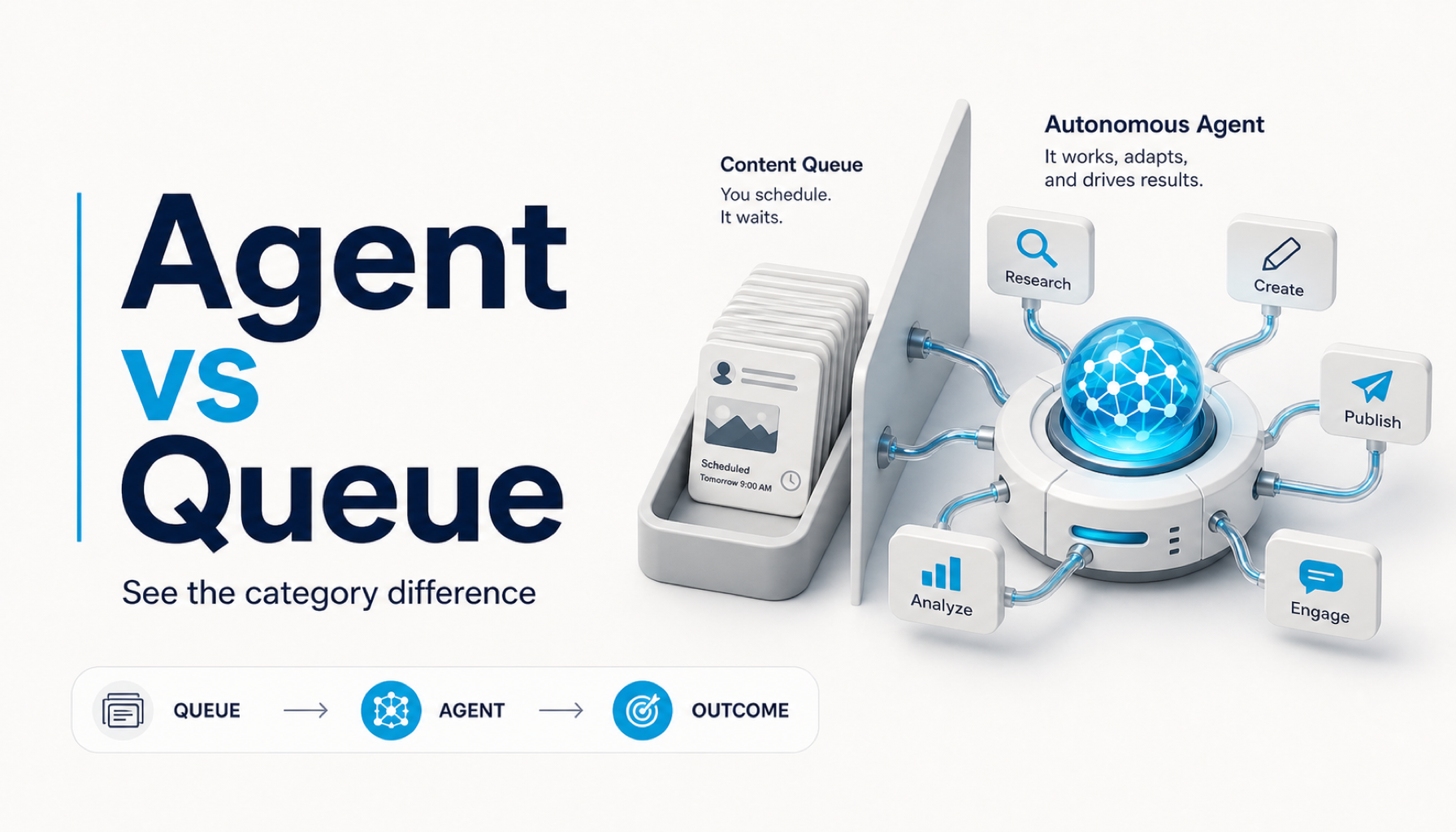
AICMOHQ is the only tool on this list built from the ground up for the autonomous marketing use case. Rather than being a scheduling tool with some AI bolted on, it's a six-agent pipeline: Scout finds relevant conversations and opportunities on Reddit, X, LinkedIn, and Hacker News; Writer drafts content in your voice; Publisher schedules and posts; Engage handles replies and follow-ups; Analyst tracks what's working; and ICP Validator pressure-tests whether you're targeting the right people.
The setup process involves connecting your social accounts (X, LinkedIn, Reddit, GitHub), giving the Writer agent a few samples of your existing writing, and configuring whether you want fully autonomous posting or an approve-before-publish flow. The default is approval mode, which means AICMOHQ drafts everything but waits for your thumbs-up before it goes out. You can flip it to autonomous if you trust the output enough.
What stood out in testing: the Scout agent surfaced Reddit threads and X conversations I genuinely hadn't seen, and the Writer's output required very little editing once I'd fed it a dozen samples of my writing. The ICP Validator was unexpectedly useful — it flagged that I was writing for developers when my actual buyers were ops leads, which shifted my entire content strategy.
Pros: End-to-end automation across research, drafting, posting, and engagement. Multi-platform from day one. Approval flow that keeps you in control without creating overhead. ICP validation is a differentiator no other tool here has.
Cons: Requires upfront investment to set voice and tone correctly. Reddit integration is read-heavy; direct posting to subreddits requires careful config to avoid looking spammy. The credit system means you need to think about usage after the trial.
Pricing: 7-day trial. Pro at $49/month for 2,000 credits — covers a serious content volume for one founder.
Tool 2: Taplio — LinkedIn Specialist
Taplio has carved out a strong niche as the go-to tool for LinkedIn growth. If your ICP lives primarily on LinkedIn and you want to build a personal brand there, it's genuinely well-executed. The AI helps you generate post ideas, write in your style, and schedule content. The engagement features let you comment on other people's posts in bulk, which is controversial but effective for early traction.
In testing, Taplio's LinkedIn-specific features were the best of any tool here. The post inspiration feature surfaced relevant conversations in my niche. The post templates were actually good, not just fill-in-the-blank generics. And the analytics gave me clear signal on what formats (carousels, text posts, polls) performed best for my audience.
The problem is the wall you hit the moment you want to post anywhere other than LinkedIn. Taplio doesn't do X, Reddit, or GitHub. If your marketing strategy involves more than one platform — and for most B2B SaaS founders it should — you're running a second tool alongside it, which defeats the efficiency argument.
Pros: Best-in-class LinkedIn features. Strong analytics. Good voice calibration. Active community of founders using it.
Cons: LinkedIn only. No opportunity discovery outside LinkedIn. Engagement automation features risk looking inauthentic if not used carefully. At $65/month for the standard plan, it's expensive for what's effectively a single-platform tool.
Pricing: $65/month (standard). No meaningful starter tier — 7-day trial only.
Tool 3: Buffer — Scheduling Workhorse
Buffer is the scheduling tool that's been around long enough that most founders have at least tried it. It does exactly what it says: you write content, Buffer schedules and posts it. The interface is clean, the multi-platform support is solid (X, LinkedIn, Instagram, Facebook, Pinterest, TikTok, Mastodon), and the team collaboration features are good if you ever hire.
But "you write content" is the operative phrase, and it's the limitation. Buffer is a publishing layer, not a marketing intelligence layer. There's no opportunity discovery, no AI writer that learns your voice, no ICP validation, no engagement automation. The AI features they've added feel bolted on — an AI assistant that helps you rewrite posts, but doesn't find opportunities or draft from scratch.
For a solo founder who already has a content process and just needs a reliable scheduler, Buffer is fine. But if you're time-constrained and want the tool to do the thinking, Buffer doesn't get you there. It automates the last 10% of the marketing workflow (distribution) and leaves you to handle the other 90% yourself.
Pros: Reliable, battle-tested scheduling. Widest platform coverage of any tool here. Clean interface. Generous starter tier (3 channels). Good analytics at higher tiers.
Cons: No opportunity discovery. No meaningful AI voice customization. No engagement automation. No ICP tooling. Essentially a distribution tool, not an intelligence tool.
Pricing: Starter tier. Essentials at $6/month/channel. Team features at $12/month/channel.
Tool 4: Hypefury — X-Focused Growth
Hypefury is what Taplio is to LinkedIn, but for X/Twitter. It's purpose-built for X growth: thread writing assistance, auto-retweet of your best posts, auto-plug (reply to a viral post with your product link), and a queue system that keeps your X feed active even when you're not.
The thread writing features are genuinely good. Hypefury's AI can take a rough idea and scaffold a thread structure, and the editor makes it easy to see how the thread will render before posting. The inspiration feature surfaces viral content in your niche that you can riff on. And the auto-retweet of your evergreen content means posts don't disappear after 24 hours.
Like Taplio, the limitation is platform depth vs. platform breadth. Hypefury is excellent at X, mediocre at LinkedIn (basic cross-posting, no X-equivalent intelligence), and absent everywhere else. If X is your primary channel and you're deliberately doubling down on it, Hypefury makes sense. If you want to be everywhere your ICP is, you're still running multiple tools.
Pros: Best X-specific features. Thread writing is a genuine differentiator. Auto-retweet and auto-plug features drive real engagement. Good analytics for X growth.
Cons: X-primary with weak LinkedIn support. No Reddit, GitHub, or HN coverage. No opportunity discovery or ICP tooling. Auto-plug features can feel spammy if overused.
Pricing: Starter tier. Standard at $19/month. Business at $49/month.
Tool 5: Typefully — Thread Writer for Deep Thinkers
Typefully occupies a different niche from the other tools here: it's primarily a writing tool with scheduling attached, rather than a scheduling tool with writing attached. The editor is excellent — focused, optimized for threads, with a side-by-side preview that shows exactly how each tweet in a thread will render.
The AI features in Typefully are more about helping you write better than automating the writing for you. It can expand a bullet point into a full tweet, suggest continuations, and spot tweets that are too long. But it doesn't discover opportunities, draft from scratch based on a topic, or learn your specific voice over time.
For founders who enjoy writing and want help making their writing better and publishing it efficiently, Typefully is the best dedicated tool. For founders who want marketing to run with minimal daily input, it doesn't solve the problem. It makes the writing part of the job faster, but it doesn't replace the strategic and research work that comes before writing.
Pros: Best writing experience of any tool here. Excellent thread editor and preview. Clean, focused interface. Reasonable pricing. Good for LinkedIn and X cross-posting.
Cons: Writing-first tool — doesn't discover opportunities or draft from scratch. No Reddit or GitHub coverage. No analytics beyond basic engagement. No ICP tooling. Still requires significant daily input from you.
Pricing: Starter tier. Starter at $8/month. Creator at $25/month.
Head-to-Head Comparison
| Criteria | AICMOHQ | Taplio | Buffer | Hypefury | Typefully |
|---|---|---|---|---|---|
| Automation depth | Full pipeline | Drafting + scheduling | Scheduling only | Drafting + scheduling | Writing + scheduling |
| X/Twitter | Yes | No | Yes | Primary | Yes |
| Yes | Primary | Yes | Basic | Yes | |
| Yes | No | No | No | No | |
| Opportunity discovery | Yes (Scout agent) | Limited | No | Limited | No |
| Voice customization | Yes | Yes | Minimal | Limited | Limited |
| Approval workflow | Yes (built-in) | Yes | Yes | Yes | Yes |
| ICP validation | Yes | No | No | No | No |
| Engagement automation | Yes (Engage agent) | Yes | No | Yes | No |
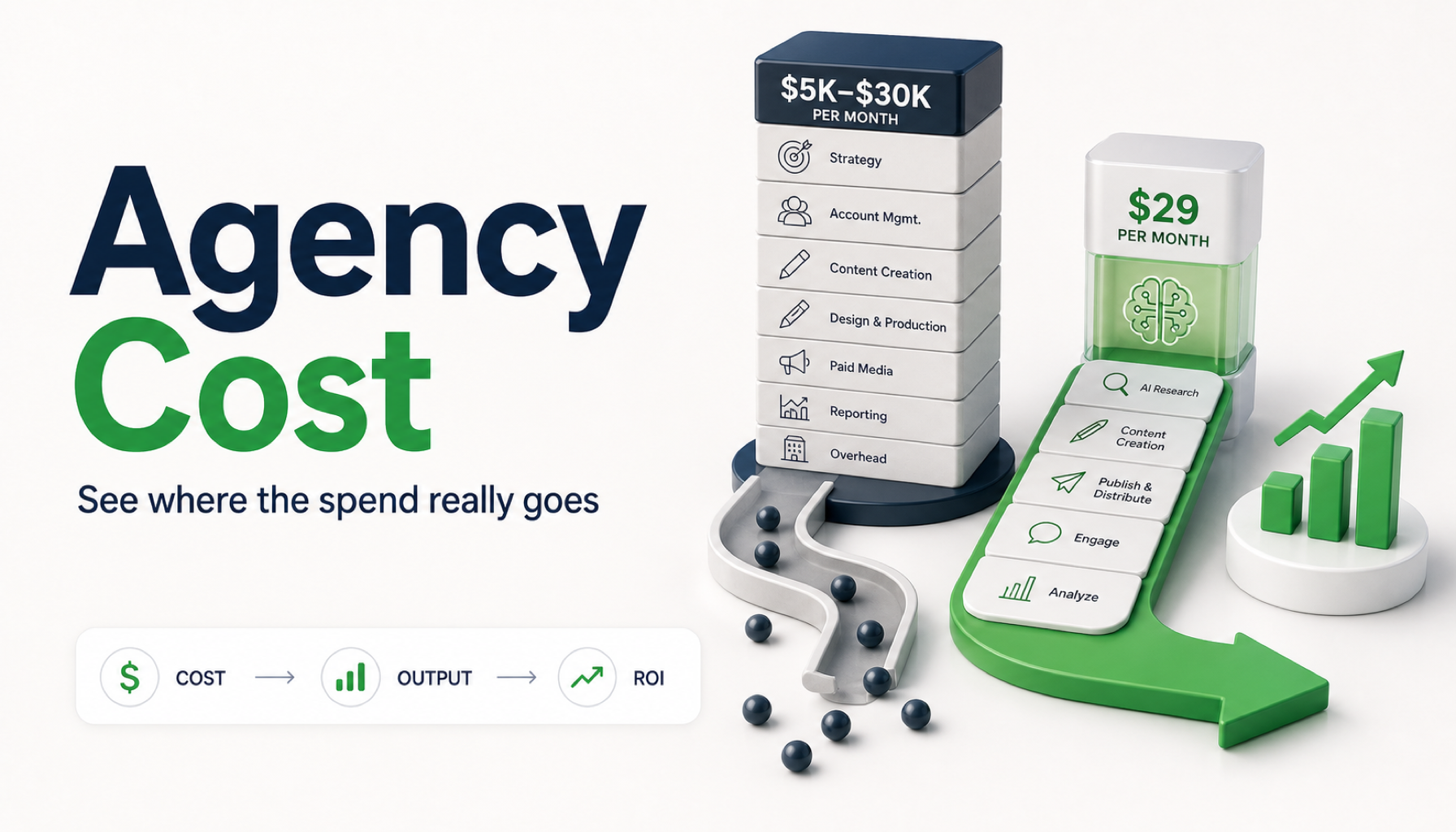
| Pro pricing/mo | $29 | $65 | ~$20 | $19 | $25 |
Which Tool to Choose Based on Your Stage
The right tool depends as much on where you are in the journey as it does on your channel preferences.
Pre-launch: You're still finding your ICP
This is where AICMOHQ's ICP Validator agent is the most underrated feature in this whole comparison. Most founders go to market with a hypothesis about who they're building for, then spend six months posting content that gets good engagement from the wrong people. Having a tool that actively challenges your ICP assumption — before you've built a content library around it — saves you enormous amounts of time.
If you're pre-launch and your priority is figuring out who to talk to and where they hang out, start with AICMOHQ's 7-day trial. The Scout agent will surface where your potential customers are actually having conversations, and the ICP Validator will tell you whether your assumption holds up.
Launched, building audience: You need consistent presence
Once you're live and the job is building an audience, the key question is which platform is actually worth your time. If your testing shows your ICP lives on LinkedIn, Taplio is the highest-leverage tool at this stage. If it's X, Hypefury or Typefully depending on whether you want growth tools or writing quality. If it's across multiple platforms, you're back to needing a multi-channel solution like AICMOHQ.
The worst outcome at this stage is posting consistently on the wrong platform. A tool that helps you discover where your audience actually is — not where you assume they are — is worth more than one that helps you post more on the platform you've already picked.
Buffer is fine here if you've already figured out your content process and just need a reliable scheduler. But it won't help you figure anything out — it just executes.
Scaling: You want marketing to run itself
Once you have product-market fit and a content strategy that's working, the goal shifts to systematizing it. This is where autonomous operation matters most. AICMOHQ's approve-then-post workflow (or full autonomous mode if you trust it) lets you reduce marketing from a daily active task to a weekly review and approval session. The Analyst agent surfaces what's working so you can double down without doing the analysis yourself.
At this stage, the single-platform tools (Taplio, Hypefury, Typefully) start to show their limits. Your audience doesn't live in one place, and covering them all means tool sprawl. The consolidation argument for a multi-agent platform like AICMOHQ gets stronger as you scale, not weaker.
The Honest Bottom Line
If I had to pick one tool for a solo founder building a B2B SaaS product in 2026, the choice depends on one question: do you want a tool that makes you a better marketer, or a tool that does your marketing?
Typefully and Taplio make you better. They're excellent craft tools for founders who enjoy writing and want to do it more effectively. If you have time to write and just want help making it better and distributing it efficiently, these are solid choices.
AICMOHQ does the marketing. It's not a tool you use — it's a system that runs. The difference is real: instead of opening a content tool every morning to write, you open AICMOHQ to review a queue of drafted content, approve what looks good, and close it. The Scout agent found conversations I genuinely wouldn't have found myself. The Writer's output in my voice required less editing than I expected. The Analyst showed me that my Reddit posts were driving three times the signups of my LinkedIn posts, which completely changed my platform prioritization.
For the solo founder who needs marketing to happen without being the one doing it all day, that's a different value proposition from any other tool in this list — and at $29/month, it's hard to argue against testing it.
Ready to Automate Your Marketing?
If you're tired of marketing being the thing that falls off your plate every time a bug comes in, start your AICMOHQ trial. The trial is enough to run the full agent pipeline on your existing accounts and see what Scout surfaces and what Writer drafts. You'll know within a week whether the autonomous approach is right for how you work — and if it is, $49/month to get your evenings back is the easiest ROI calculation you'll make this year.