AI Strategy
What Is an AI CMO? Definition, Use Cases & When You Actually Need One
Most solo founders don't need a Chief Marketing Officer. They need someone — or something — to do the actual work: find where their customers hang out, write content that doesn't sound like a press release, post it consistently, respond to comments, and tell them what's working. That's not a CMO. That's a full-time marketing team. An AI CMO collapses that entire function into a system you can run for less than a hundred dollars a month.
But "AI CMO" gets thrown around loosely. Some people use it to mean a ChatGPT wrapper that drafts tweets. Others mean a full autonomous loop that runs without them. The gap between those two things is enormous — in capability, in trust requirements, and in when each is actually appropriate. This piece cuts through the noise.
What an AI CMO Actually Is
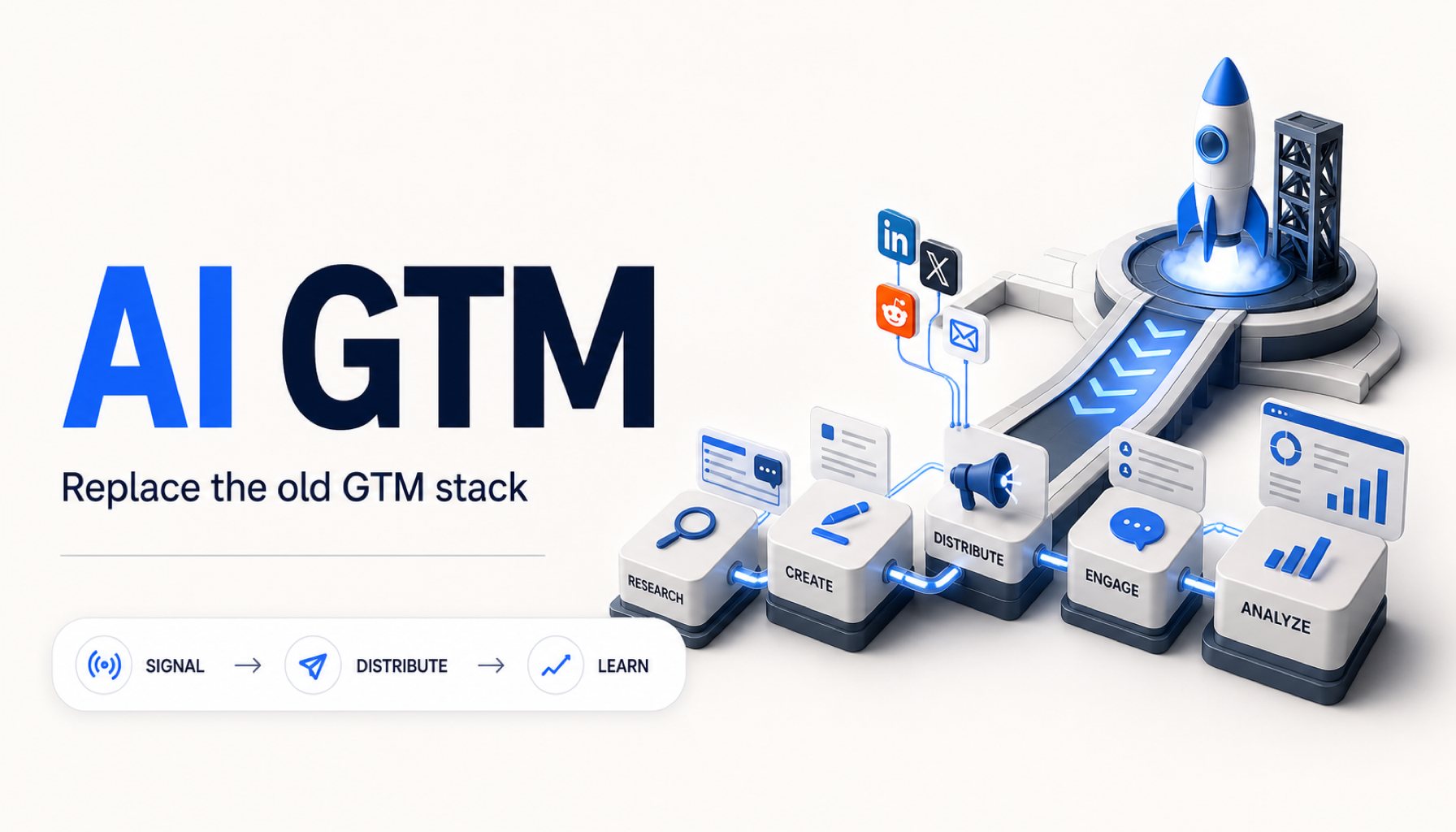
An AI CMO is not a chatbot. It's not a content scheduler with an AI button bolted on. It's a marketing system that executes the full marketing loop autonomously: research, creation, distribution, engagement, and measurement — without a human in the loop for each step.
The distinction matters because most tools only automate one part of that loop. Buffer schedules posts you already wrote. Jasper helps you write faster if you know what to write. SEMrush tells you what keywords to target. Each of these is a point tool. An AI CMO connects all the steps into a pipeline that runs continuously.
Think of it this way: a human CMO manages a team and a strategy. An AI CMO is the team. It doesn't manage; it executes. That's both its strength and its limitation.
An AI CMO doesn't replace strategic judgment. It replaces the 40 hours a week you'd spend executing decisions you've already made.
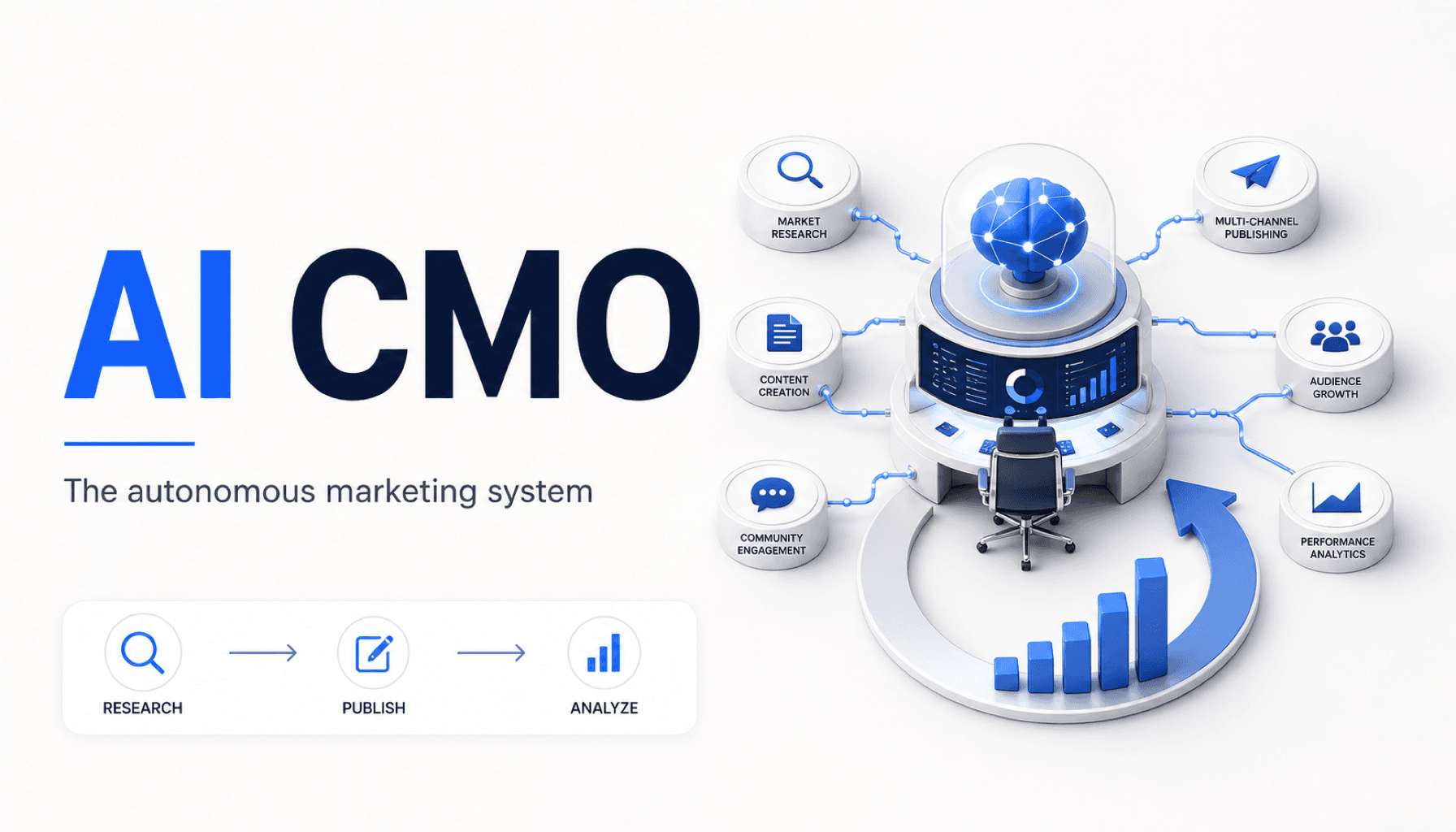
The architecture of a real AI CMO involves several coordinated agents, each responsible for one layer of the stack. Scout agents monitor platforms for relevant conversations and opportunities. Writer agents draft content tuned to your voice and audience. Publisher agents handle scheduling and cross-platform distribution. Engage agents manage replies and follow-up. Analyst agents surface performance data and surface what's working. ICP Validator agents make sure you're still talking to the right people.
When these agents are connected and share state — when the Analyst feeds back into the Scout, and the Scout's findings shape what the Writer produces — you have something that approximates a real marketing function, not just a collection of automations.
What an AI CMO Does Day-to-Day
In practice, an AI CMO running at full capacity handles five categories of work:
1. Research and opportunity detection
It monitors Reddit threads, X conversations, LinkedIn posts, Hacker News discussions, and GitHub activity for signals: questions your product answers, competitors being criticized, niche communities waking up to a problem you solve. Human marketers do this manually and sporadically. An AI CMO does it continuously. When a thread surfaces on r/SaaS asking "why are there no good [X] tools," your system flags it, drafts a genuine reply, and queues it for your review before you've even seen the notification.
2. Content creation at volume
Writing is the bottleneck for most solo founders. An AI CMO breaks that bottleneck by generating first drafts tuned to your voice — not generic AI-sounding copy, but content trained on your prior writing, your audience's language, and the specific platform's norms. LinkedIn posts read differently than X threads. Reddit replies that don't feel like marketing require a different register. A good AI CMO handles those distinctions without you configuring each one.
3. Publishing and scheduling
Once content clears your approval (or runs autonomously, if you've enabled that), it distributes across connected platforms with proper formatting, optimal timing, and platform-specific variations. No copy-paste between tabs. No forgetting to post on Thursday because you were heads-down in the product.
4. Engagement and replies
Comments and DMs don't stop when you stop checking them. An AI CMO handles initial engagement — answering questions, thanking responses, routing serious leads to your inbox — so the conversation doesn't go cold while you're building.
5. Analytics and iteration
The loop closes with measurement: which posts drove clicks, which platforms converted, which topics got traction. This data feeds back into the research and writing layers, so the system improves over time rather than just running the same playbook indefinitely.
How an AI CMO Differs from a Human CMO
| Dimension | Human CMO | AI CMO |
|---|---|---|
| Cost | $150K–$300K/yr fully loaded | $30–$300/mo depending on tool |
| Speed | Days to weeks for content cycles | Hours to minutes |
| Availability | Business hours, bandwidth-limited | 24/7, runs in background |
| Strategic judgment | Strong — reads markets, spots pivots | Weak — executes defined strategy only |
| Brand relationships | Builds genuine long-term relationships | Can't — no persistent social identity |
| Crisis handling | Essential — judgment under pressure | Not appropriate — escalate immediately |
| Voice calibration | Develops over months | Fast with examples, degrades without feedback |
| Scale | Linear with headcount | Near-zero marginal cost per additional output |
The cost and speed advantages are obvious. What's less obvious is the strategic gap. A human CMO who has worked in your market for ten years has pattern recognition an AI system simply cannot replicate. They know which journalists to call, which partnerships are worth pursuing, which channel shift is coming six months before it shows up in the data. An AI CMO executes the current playbook extremely well. It doesn't write the next one.
For most solo founders at the early stages, that's actually fine. You don't need someone to write the next playbook. You need someone to execute the playbook you already have, consistently, while you focus on building.
The 3 Types of Founders Who Actually Need One
Not every founder is the right fit for an AI CMO. Here are the three archetypes where it delivers the most leverage:
1. Pre-PMF founders who need signal, not scale
You're still figuring out who your customer is and what message lands. You don't need to publish 20 pieces a week — you need to be in the right conversations, watching for signals, and testing angles quickly. An AI CMO's Scout and Analyst agents are particularly valuable here: they tell you where your potential customers are talking and what they're saying, which is intelligence you can't afford to miss when every week of misdirected effort costs you.
2. Post-PMF founders scaling before they can hire
You've validated the product. You know who buys it and why. Now you need to amplify that message across multiple platforms without burning yourself out writing content at midnight. This is the highest-leverage moment for an AI CMO: the strategy is defined, the voice is established, and you just need execution at scale. Tools like AICMOHQ are built for exactly this window — between "I figured it out" and "I can afford a marketing hire."
3. Bootstrapped founders who will never hire a marketing team
Some businesses are intentionally small. If you're running a profitable, lifestyle-oriented SaaS with 200–500 customers and no plans to raise or hire, a full marketing function will always be out of reach financially. An AI CMO lets you maintain a consistent content and distribution presence that would otherwise require two to three hires. For permanently bootstrapped founders, it's not a stopgap — it's a permanent infrastructure decision.
What an AI CMO Cannot Do
This section matters more than the capabilities section. Over-trusting automation is how you create messes that are expensive to clean up.
Brand relationships at the partnership level. Sponsorships, co-marketing deals, joint webinars, podcast appearances — these are built on personal trust that develops over time through real human interaction. An AI can draft the outreach email. It cannot close the relationship. If you're trying to build distribution through partnerships, a human has to own that track.
Crisis management. If a post lands wrong, a product has a public incident, or a competitor starts a narrative about your company, the last thing you want is an autonomous system responding. Turn off autonomous mode immediately. Any real crisis communication needs human judgment, human accountability, and a human voice that can be held responsible. AI-generated crisis responses can make things catastrophically worse.
Strategic pivots. An AI CMO optimizes for what's working within your current strategy. It cannot tell you that your current strategy is wrong. If your ICP is off, if you're on the wrong platform, if the category narrative you're using is collapsing — none of that registers as a problem in the data until it's too late. A human still needs to do strategy reviews, read the market, and make pivot decisions. The AI executes; you think.
Long-form thought leadership that moves markets. A genuinely influential essay, a contrarian take that changes how people think about a problem, a piece of writing that gets quoted for years — these come from a founder's hard-won perspective, not from an AI drafting in their voice. AI-assisted drafting is fine. Pure AI generation of your flagship thought leadership pieces will produce something technically correct and intellectually inert. Your real perspective is the asset. Use the AI to amplify it, not replace it.
AICMOHQ as an AI CMO Implementation
AICMOHQ is built specifically around this architecture. It connects to X/Twitter, LinkedIn, Reddit, and GitHub, then runs six coordinated agents: Scout finds opportunities across those platforms, Writer drafts content in your voice, Publisher handles scheduling and distribution, Engage manages replies, Analyst tracks performance, and ICP Validator keeps you honest about whether you're still talking to the right people.
The design philosophy is "approve-first by default." You review content before it publishes. You can flip it to autonomous mode once you trust the system, but the default is a human checkpoint on every post. That's intentional — especially early on, when the system is still learning your voice and you're still calibrating what messages land.
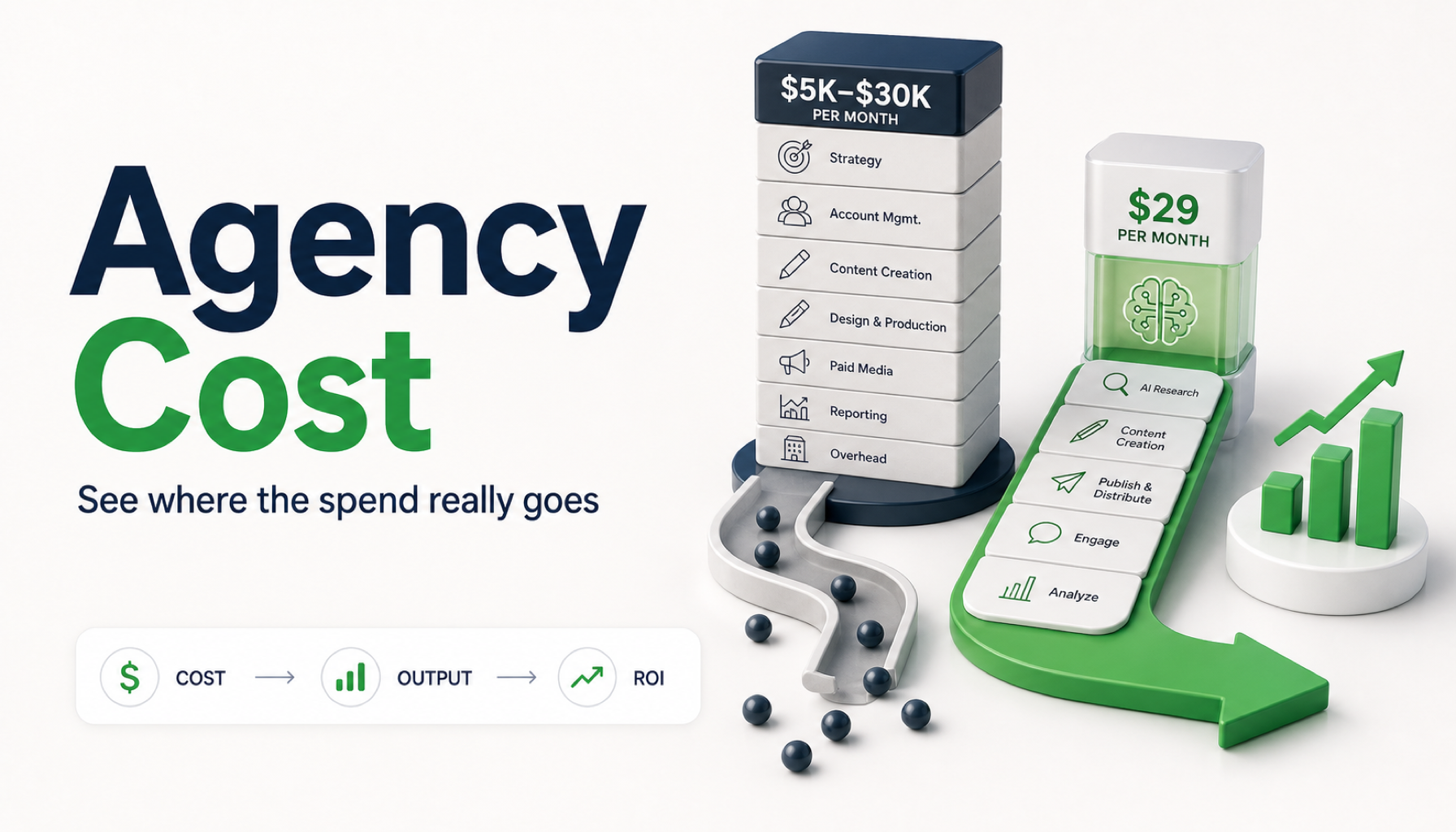
The credit system maps directly to the leverage equation: 2,000 credits on Early Startup, 2,000 credits per month on Pro at $29. For a founder posting daily across three platforms, that's a full month of content operations for less than the cost of one hour with a freelance copywriter.
What AICMOHQ doesn't try to do is tell you what your strategy should be. The platform assumption is that you've already figured out who you're talking to and roughly what you want to say. It handles execution. Strategy is still yours.
How to Evaluate AI CMO Tools
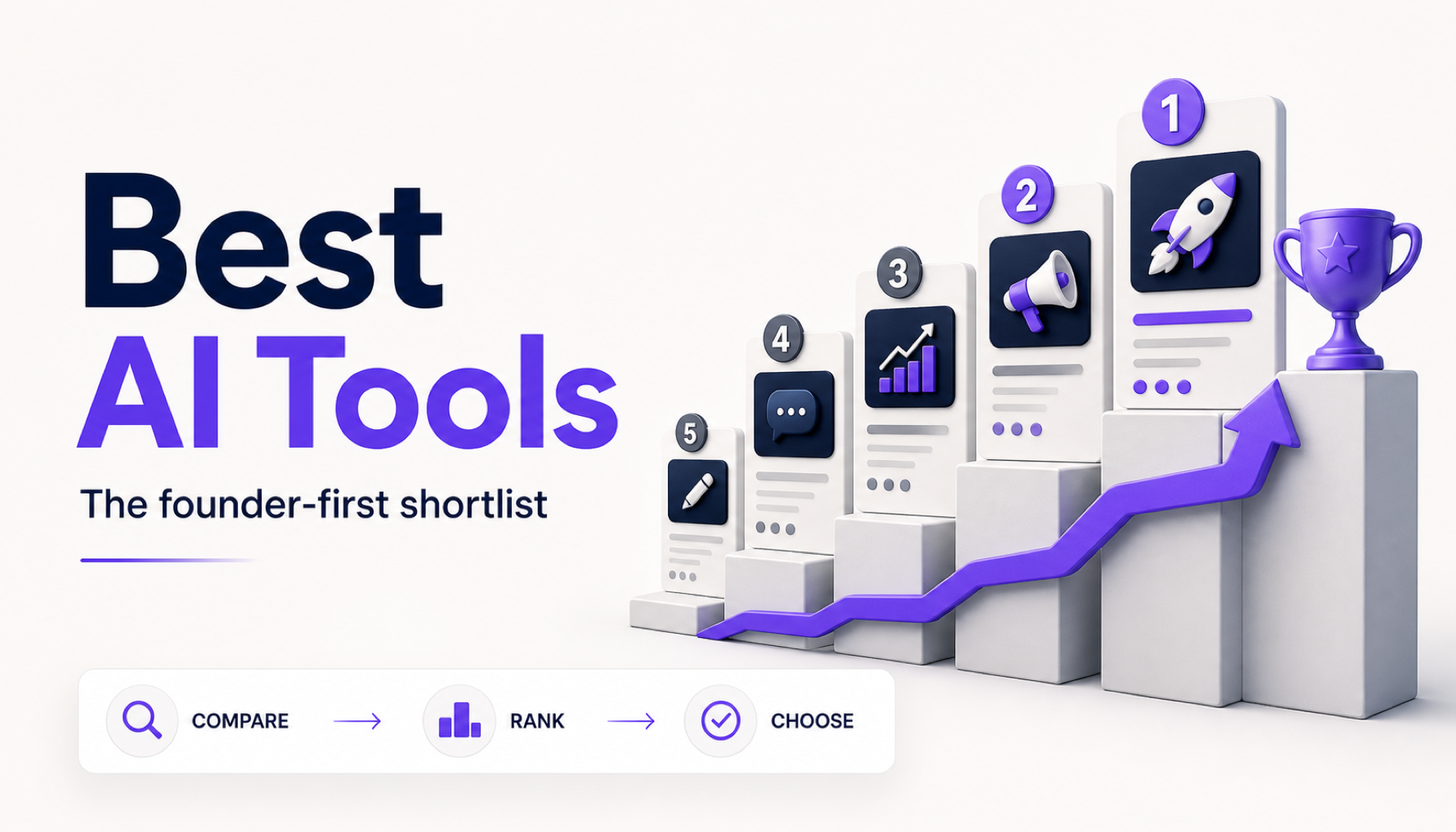
If you're comparing tools in this category, here's what actually matters — not what the landing pages emphasize:
Full-loop vs. point-tool. Does the tool connect research to creation to distribution to analytics in a single workflow, or does it do one thing well and hand off to your other tools? Point tools are fine if you want to stay in control of the workflow. A full-loop system is what you want if the goal is to get out of the workflow entirely.
Voice fidelity. How does the system learn your writing style? Does it train on your past content, or does it use a generic "brand voice" config? The gap between these two approaches is immediately obvious in the output. Ask for sample output before committing.
Platform breadth and depth. A tool that posts to LinkedIn and stops there isn't an AI CMO — it's a scheduling tool with an AI badge. Look for native integrations with the platforms where your audience actually is, with platform-specific formatting logic (not just copy-paste of the same text).
Human-in-the-loop controls. Can you approve posts before they go out? Can you set different autonomy levels per platform or per post type? A system that only runs fully autonomous or fully manual is too coarse for most founders' needs. You want to be able to trust some tasks and stay close to others.
Analytics that close the loop. Performance data is only useful if it feeds back into content decisions. Look for tools where the analytics layer informs the Scout and Writer layers — not just a dashboard of vanity metrics.
Transparent pricing without credit gotchas. Some tools charge per generation, which makes costs unpredictable. Others bundle operations into a monthly credit pool you can reason about. Know exactly what a month of active use costs before you sign up.
Ready to Automate Your Marketing?
If you're a solo founder spending more time thinking about marketing than doing it — or more time doing it manually than you should be — an AI CMO is worth a serious look. The category has matured enough that the gap between "AI writing assistant" and "autonomous marketing system" is real and measurable. AICMOHQ is built for founders who want to operate the latter: a six-agent system that researches, writes, publishes, engages, and analyzes — so you can stay focused on building the product. Start your AICMOHQ trial and see what a full marketing loop running without you actually feels like.