AI GTM
What Is AI GTM? How AI Agents Are Replacing Your Go-To-Market Stack
Three years ago, launching a product meant hiring a content marketer, contracting an SEO agency, buying a suite of outreach tools, and hoping the combination produced enough signal to find customers. Today, a solo founder can wire up a set of AI agents over a weekend and have them researching Reddit threads, drafting LinkedIn posts, scheduling tweets, replying to comments, and surfacing analytics — automatically, continuously, at a cost that fits in a lean paid plan. That shift has a name now: AI GTM. And it is moving faster than most growth teams realize.
What AI GTM Actually Means
Go-to-market has always been the set of activities that connects a product to the people who need it: finding where those people are, creating content that speaks to their problems, getting that content in front of them, managing the conversation it starts, and measuring what worked. None of that has changed. What has changed is who — or what — executes it.
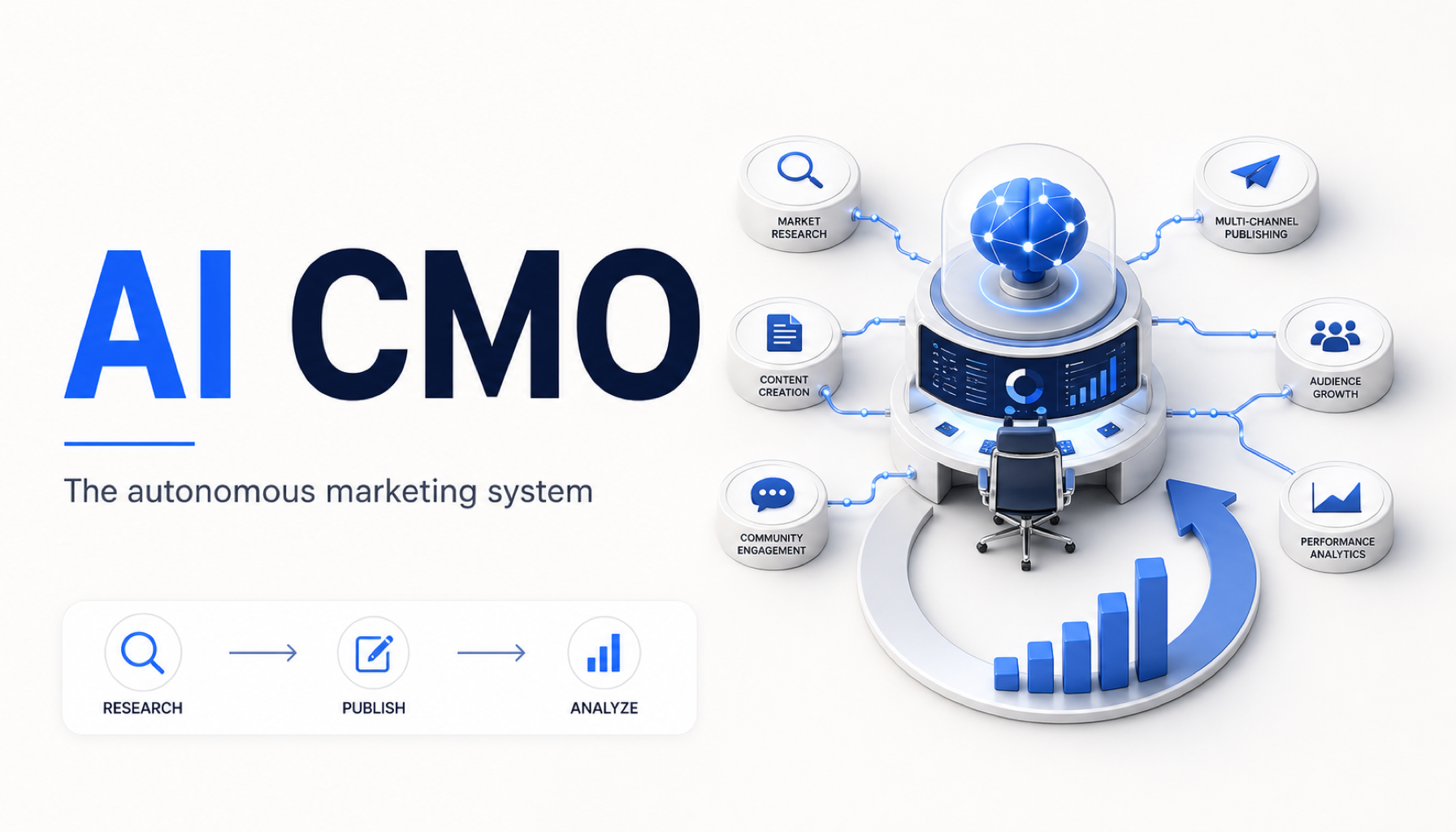
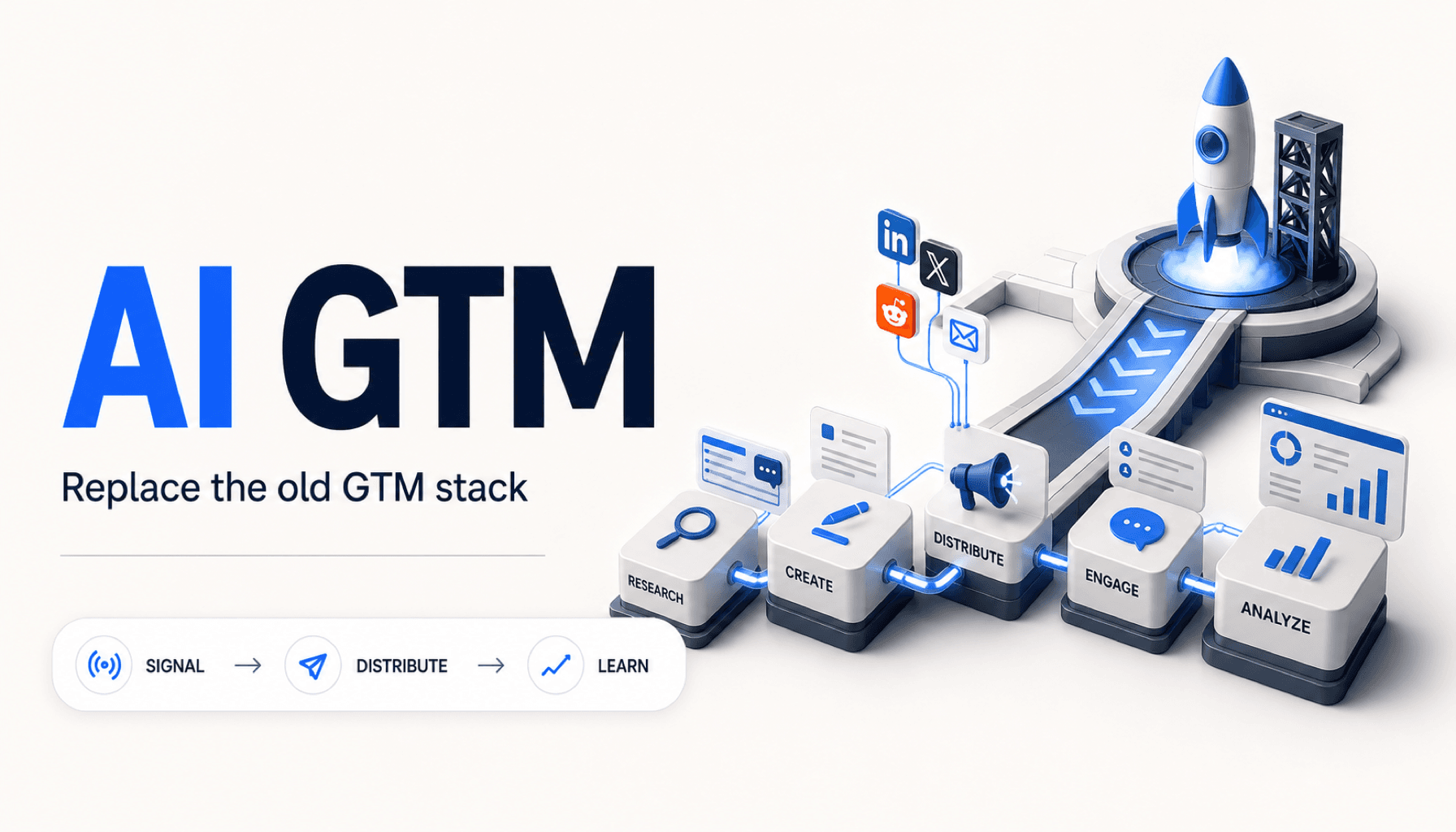
AI GTM is the practice of using AI agents to execute go-to-market activities automatically. Not to assist a human doing those activities, but to own the execution loop: research a market, draft content calibrated to that market, distribute across channels, engage with the responses, and feed the results back into the next research cycle.
This is different from "using AI to write faster." A copywriter using ChatGPT to draft headlines is still doing GTM the old way — humans in the loop at every decision point. AI GTM means the agents run the loop. Humans set the strategy, approve the output, and adjust the direction. The agents handle everything in between.
The distinction matters because it changes the economics completely. A human marketing team scales linearly with headcount. An AI GTM system scales with configuration. You do not hire a second Scout to cover another subreddit — you add it to the agent's watchlist. The marginal cost of reaching a new channel approaches zero.
The Old GTM Stack vs. AI GTM
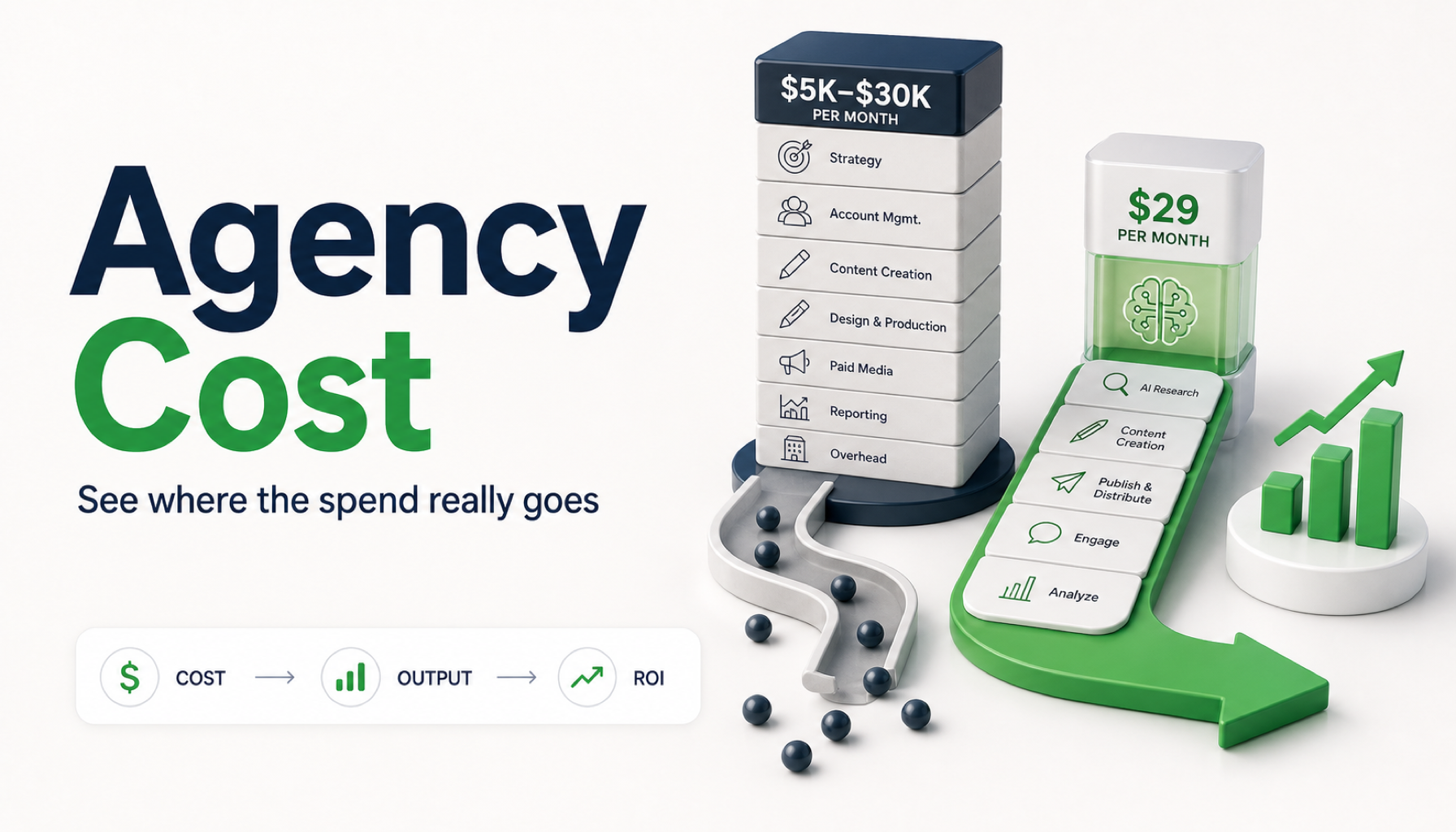
To understand why AI GTM is gaining traction so fast, it helps to price out what it replaced. A typical early-stage B2B startup running a traditional GTM motion in 2023 would have assembled something like this:
| Role / Tool | Monthly Cost | What It Did |
|---|---|---|
| Content marketer (part-time) | $3,000–$5,000 | Blog posts, LinkedIn updates, email newsletters |
| SEO agency retainer | $2,000–$4,000 | Keyword research, backlink outreach, content briefs |
| Social media manager | $1,500–$3,000 | Twitter/LinkedIn scheduling, community replies |
| Outreach tool (Lemlist, Apollo) | $200–$500 | Cold email sequences, LinkedIn outreach |
| Analytics / attribution | $200–$600 | Traffic, conversion, channel ROI reporting |
Call it $7,000–$13,000 per month at the low end. For a pre-revenue or early-revenue founder, that is either impossible or a bet that burns runway before the channel pays off. So most founders just did not do GTM properly. They shipped the product, posted on launch day, and wondered why growth was flat.
AI GTM does not replace all of that perfectly — the quality ceiling for truly exceptional creative work still belongs to experienced humans. But it replaces the execution — the finding, drafting, scheduling, posting, replying, and reporting — at a fraction of the cost, running continuously rather than during business hours.
The Five Components of an AI GTM System
A complete AI GTM system has five functional layers. Each corresponds to a category of work that used to require a different human specialist or tool:
1. Research and Signal Detection
This is the intelligence layer. Agents monitor Reddit threads, Twitter conversations, LinkedIn posts, Hacker News, and GitHub activity for signals: product pain points, competitor mentions, buying intent, trending topics in your space. The output is a prioritized feed of opportunities — a Reddit thread where your ICP is describing exactly the problem you solve, a Twitter conversation where a competitor's users are frustrated. Without this layer, you are guessing where to show up. With it, you show up where the conversation already is.
2. Content Generation
Research feeds content. An agent takes the signal — this Reddit thread, this pain point, this audience — and drafts a response, a post, or an article calibrated to it. The critical constraint here is voice. Generic AI content is immediately recognizable and performs poorly. The best AI GTM systems train or prompt the writing agent on the founder's actual words: past posts, emails, interviews. The agent should sound like you, not like a press release.
3. Distribution and Scheduling
Content that is not distributed does not exist. The distribution layer handles the mechanics: posting to X at optimal times, publishing to LinkedIn, queuing Reddit comments, scheduling newsletters. More sophisticated setups cross-post with platform-native formatting — a thread on X, a long-form take on LinkedIn, a direct comment on the relevant subreddit — rather than blasting identical copy everywhere. Platform-native content dramatically outperforms crossposts on reach.
4. Engagement and Conversation Management
Distribution starts a conversation. Engagement continues it. This layer monitors replies, comments, and DMs and either handles them automatically (thanking, clarifying, routing to resources) or queues them for human review. This is the layer most teams skip, which is why their content generates impressions but not relationships. Replies are where trust is built.
5. Analytics and Feedback Loop
The analytics layer closes the loop. It tracks which content performed, on which channels, with which audiences, and feeds those signals back to the research layer. Over time, the system learns what resonates with your specific ICP and adjusts. This is what separates a static automation from a system that compounds.
Why Solo Founders Adopted AI GTM First
You might expect large marketing teams to be the early adopters of AI GTM — they have the budget and the existing infrastructure. In practice, the opposite happened. Solo founders and tiny teams were first, and for an obvious reason: they had nothing to protect.
A ten-person marketing team with established workflows, agency relationships, and channel playbooks has strong incentives to keep those things. Swapping in AI agents means someone's job function changes, agency contracts end, and institutional knowledge gets disrupted. Even if the outcome would be better, the friction is real.
A solo founder running a $0 marketing budget has none of that friction. They have a product, a laptop, and a growth problem. An AI GTM system that costs $29 per month and covers research, content, distribution, and engagement is not a disruption — it is the only option that makes economic sense.
"I was spending six hours a week manually monitoring Reddit and writing posts. Now my Scout agent does the monitoring, flags the relevant threads, and drafts my responses. I spend thirty minutes reviewing and approving. That freed time went back into the product."
This is the pattern: founders are not using AI GTM to replace marketing they were doing well. They are using it to do marketing they were not doing at all because it was too time-consuming. The counterfactual is not an experienced marketing team — it is nothing.
Common AI GTM Mistakes
The early cohort of founders who moved fast on AI GTM also generated a useful set of failure modes. Three show up repeatedly:
Over-automating before validating
The temptation is to flip every agent to autonomous mode and let the system run. The founders who did this before validating their ICP and voice ended up with high-volume content that generated no signal — or worse, content that damaged their reputation by feeling spammy. The right sequence is: run in approval mode for the first few weeks, review every piece of output, understand what the agent gets right and wrong, then gradually increase automation on the things it handles well.
Losing brand voice
Generic AI writing is easy to spot and easy to ignore. Founders who did not invest in voice configuration — feeding the system examples of their actual writing, setting explicit tone guidelines — ended up with technically correct content that sounded like nobody. The fix is not writing better prompts; it is providing more first-person examples. The agent needs evidence of your voice, not instructions about it.
No approval layer on first-party content
There is a meaningful difference between an agent posting a comment on a Reddit thread and an agent posting as your brand on LinkedIn. Community participation can be nearly fully automated with reasonable guardrails. First-party brand content — posts that go out under your name, emails to your list — should have an approval step until you have high confidence in the agent's judgment. An approve-first default is not a failure of automation; it is a risk management decision. Tools like AICMOHQ default to approval mode precisely because the cost of a bad post outweighs the cost of a thirty-second review.
How to Build an AI GTM Stack from Scratch
If you are starting from zero, here is the sequence that works:
- Define your ICP before touching any tool. AI GTM amplifies your targeting. If your targeting is vague, the system will generate vague content at scale. Write two or three specific profiles: job title, company size, core pain, where they spend time online, what they already believe about the problem you solve.
- Map your channels. You do not need to be everywhere. Pick two or three channels where your ICP actually exists. For B2B SaaS, that is usually LinkedIn plus one community (Reddit, a Slack group, HN). For consumer, it might be Twitter and TikTok. Start narrow — the system can expand later.
- Connect your integrations. Your AI GTM system needs read access (to monitor channels) and write access (to post). Set up OAuth connections for each channel. This is infrastructure work you do once.
- Configure voice. Provide 10–20 examples of your actual writing. Past posts, email threads, Slack messages to customers — anything that captures how you actually communicate. The more first-person examples, the better the output.
- Run in approval mode for the first month. Review everything. Correct the agent's mistakes by approving what is right and editing what is not. Build the feedback loop before increasing autonomy.
- Add analytics last. Once you have content running, instrument your analytics layer. Track which posts generate inbound, which channels drive signups, which content formats resonate. Use that data to adjust the research and content layers.
The whole stack does not need to be built at once. Most founders who do this well start with just the research and content layers — understanding where their ICP is and drafting content for those places — before adding distribution automation and then engagement. Resist the urge to turn everything on simultaneously.
AICMOHQ as a Complete AI GTM Platform
AICMOHQ was built specifically for this use case — solo founders who need a complete AI GTM system without a team. It ships six agents that map directly to the five layers described above: Scout (research), Writer (content), Publisher (distribution), Engage (conversation management), Analyst (analytics), and ICP Validator (audience calibration).
Each agent connects to the channels where early-stage B2B founders actually operate: X/Twitter, LinkedIn, Reddit, and GitHub. The ICP Validator agent deserves specific mention — most AI GTM tools skip audience validation entirely, which means you can run a polished system pointing at the wrong customer. The Validator runs your assumptions against actual market signals and flags mismatches before you scale a message that does not land.
The credit system is also worth understanding. Rather than charging per seat or per channel, AICMOHQ charges per agent action — 2,000 credits on Early Startup, 2,000 per month on the Pro plan at $29. That structure means you pay for what actually runs, not for access. A founder doing focused outreach on two channels uses far fewer credits than one trying to blanket five platforms simultaneously.
The default mode is approval-first. Every piece of content the agents draft goes to your review queue before it posts. You can shift specific agents or content types to autonomous mode once you trust their output — but the default protects you from the over-automation mistake described earlier. That is a deliberate product decision, not a limitation.
If you are evaluating AI GTM tools, the questions to ask are: Does it cover the full loop (research through analytics, not just content generation)? Does it have native channel integrations, or does it rely on third-party connectors that break? Does it have an approval layer? Does it give you voice control? AICMOHQ was designed around those questions specifically because the founders who struggle with AI GTM are usually missing one of them.
Ready to Automate Your Marketing?
AI GTM is not a future trend — it is the approach solo founders are using right now to compete with companies ten times their size. The tools exist, the cost is within reach, and the gap between founders who have built this system and those who have not is widening. If you are doing marketing manually, or not doing it at all because it takes too long, the leverage available here is real. Start your AICMOHQ trial and have your first agents running today.