COMPARISON
Marketing Agency Cost in 2026: What You Get for $5K–$30K/Month (And the $29 AI Alternative)
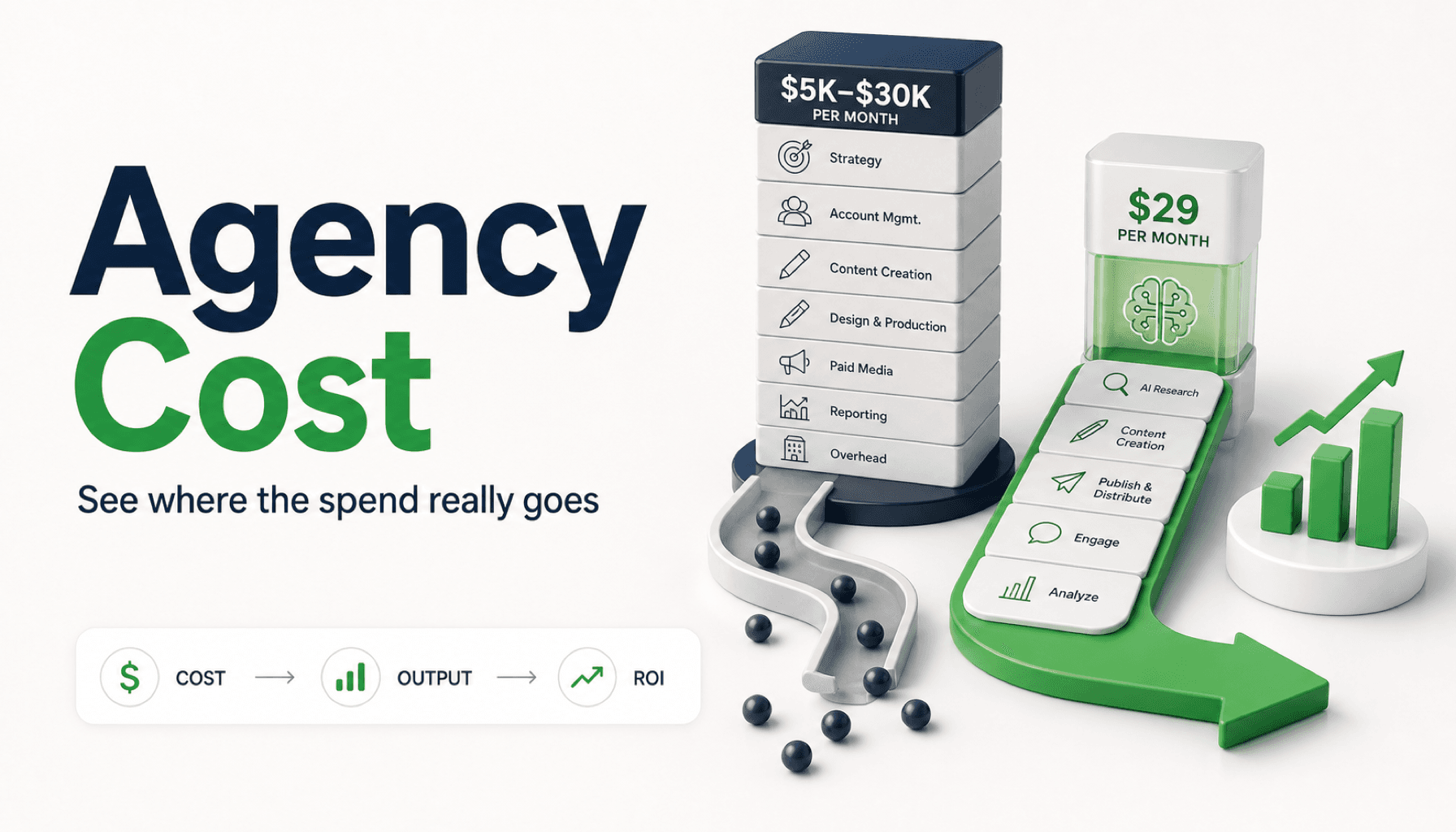
If you've ever requested a proposal from a marketing agency, you know the ritual: a polished deck, a discovery call, a "custom strategy" slide that looks identical to the one they sent the last 12 clients, and a retainer quote that starts at $5,000 a month and only goes up from there. In 2026, agency pricing has actually compressed at the low end and ballooned at the high end — partly because AI has eaten the commodity work, and partly because agencies that survived are doubling down on positioning as strategic partners. The result is a market that's harder than ever to read if you're a solo founder trying to figure out what you actually need to spend.
This post breaks down what agencies actually charge at each tier, what's included (and what mysteriously isn't), and where a $29/month AI platform can replace 80% of what a $15K retainer delivers — and where it genuinely can't.
The 2026 Agency Tier Breakdown
Agency pricing has always been a function of overhead, not value delivered. A boutique with three people and no downtown office can charge $3K and be profitable; a 40-person shop with account managers, strategists, and a fancy SoHo address needs $15K minimum to keep the lights on. Here's how the tiers actually break down in 2026:
$2K–$5K/Month: Freelancer-agency hybrids
At this tier, you're typically working with a one- or two-person operation — often a solo consultant who has slapped "agency" on their LinkedIn. You get a set number of deliverables per month: maybe 8 social posts, 2 blog articles, a monthly report, and async Slack access. Execution is handled by the founder and one contractor. Strategy is thin. These shops are valuable if you need someone to just do the work, but don't expect them to build a system, train on your voice, or care deeply about distribution. Typical clients: pre-revenue startups, local businesses, founders who need "something" on their social channels.
$5K–$10K/Month: Small boutiques
This is where you start getting a dedicated account manager and a small team of 2–4 people touching your account. Deliverables expand: content calendar, SEO audit, maybe basic paid social management, monthly strategy calls. These agencies have enough overhead to promise consistency but not enough margin to give your account serious strategic attention. You'll get templated reporting and a lot of "here's what we published this month" updates. Typical clients: Series A startups, B2B SaaS companies with $1M–$5M ARR, e-commerce brands doing $2M–$10M in revenue.
$10K–$20K/Month: Full-service regional agencies
Now you're buying a proper team: an account director, content strategists, SEO specialists, designers, and sometimes a PR contact. Monthly deliverables are comprehensive — multi-channel content, paid media management (though ad spend is usually separate), quarterly strategy reviews, and dedicated Slack channels. At this tier, agencies can actually move the needle on brand awareness and organic growth — but only after a 3–6 month ramp-up period where they're still learning your business. Typical clients: funded startups, established SMBs, companies with in-house marketing coordinators who need agency support.
$20K–$30K+/Month: The marquee shops
At $20K and above, you're paying for brand, relationships, and access to senior talent. These agencies have worked with recognizable names, have actual case studies with numbers, and can walk you into media placements and partnerships that lower-tier shops can't touch. The work is genuinely strategic — they're shaping positioning, not just executing it. But the expectation is that you have internal resources to collaborate with them: a CMO or marketing lead, an executive stakeholder who can make decisions quickly, and a content library to pull from. If you're a solo founder at this level, you're burning money.
What's Actually Included (And What Isn't)
Agency retainers are scoped by deliverables, not outcomes. This distinction will save you from a lot of confusion. When an agency quotes you $8,000/month for "social media management," they mean they will publish X posts per week. They do not mean your follower count will grow, your posts will generate leads, or anyone will reply to comments. Read the scope of work carefully — specifically for what's explicitly excluded.
Common inclusions at the $5K–$10K tier: content calendar creation, copywriting for posts, basic graphic design, scheduling, and a monthly performance report. Common exclusions that cost extra: paid ad management (typically 15–20% of ad spend on top of the retainer), video production, PR and media outreach, email marketing, website changes, and anything requiring custom development. A $7,000/month retainer can easily become $12,000 once you add a modest ad budget and video for LinkedIn.
At higher tiers, more is bundled, but custom requests — a new landing page, a product launch campaign, a speaking opportunity pitch — are usually quoted as separate projects. The retainer buys you the ongoing machine; it doesn't buy you surge capacity when you need it most.
The Hidden Costs Nobody Talks About
The monthly retainer is the most visible cost, but the hidden costs are where founders get surprised. Here's what rarely shows up in the proposal:
- Onboarding time: Most agencies need 4–8 weeks of discovery before they produce anything usable. You pay full rate during this period. Expect questionnaires, brand audits, competitor analyses, and strategy presentations before a single post goes live.
- Ramp-up period: The first 3 months of an agency engagement are almost always underperforming. They're building context, testing messaging, and calibrating to your audience. Industry-standard expectation is 6 months before you can meaningfully evaluate ROI.
- Revision cycles: Most contracts include 2 rounds of revisions per deliverable. If your voice is specific or your product is technical, you'll burn through these fast. Additional revisions are billed hourly at $100–$200/hr.
- Tool costs: Agencies use their own tool stacks and often pass costs through. Scheduling platforms, SEO tools, analytics suites — these may or may not be included in your retainer depending on how the contract is written.
- Account manager turnover: The person you sold on leaves 6 months in. You get handed to someone new who needs to re-learn your business. This happens constantly and is one of the top complaints founders have about agencies.
The real cost of a $10K/month agency over the first year isn't $120K — it's closer to $140K once you factor in onboarding, overages, ad spend fees, and the opportunity cost of the 4–8 hours per month you spend on calls, reviews, and approvals.
What Solo Founders Actually Need vs. What Agencies Sell
Agencies are built to service companies that have an existing marketing infrastructure — a brand guide, a product-market-fit hypothesis, a target customer profile, and the internal bandwidth to collaborate on strategy. They're designed to scale execution for companies that already know what's working.
Solo founders are in a completely different position. You need to figure out what works before you can scale it. You're testing messaging, finding distribution channels, validating your ICP, and doing all of this while building the product and closing sales. The agency model — structured deliverables, monthly retainers, long ramp-up periods — is almost directly opposed to what you actually need, which is speed, iteration, and feedback.
What solo founders actually need at the early stage: a way to show up consistently on the channels where their customers are, content that sounds like them (not a content farm), visibility into what's resonating, and the ability to act on signals quickly. A $10K/month agency gives you 8 polished posts and a deck. What you need is 30 posts testing 10 different angles, with a feedback loop that tells you which 3 to double down on.
The agency model optimizes for client retention, not founder outcomes. That's not a criticism — it's just the economics. Agencies need predictable revenue. That incentivizes stable, low-risk deliverables over aggressive experimentation. As a solo founder, your incentives are the opposite.
The $29 Alternative: AICMOHQ vs. Agency Tiers
AICMOHQ is built specifically for the solo founder use case — which means it's optimized for speed, iteration, and distribution, not account management overhead. Here's an honest feature-by-feature comparison:
| Capability | $5K–$10K Agency | AICMOHQ Pro ($29/mo) |
|---|---|---|
| Content calendar | Monthly, templated | AI-generated, continuously updated |
| Opportunity discovery | Not included (manual research) | Scout agent monitors Reddit, X, LinkedIn, HN daily |
| Copywriting | Human writer, ~5–10 day turnaround | Writer agent drafts in your voice, minutes |
| Scheduling & publishing | Included (basic) | Publisher agent handles X, LinkedIn, Reddit |
| Engagement / replies | Not included or extra | Engage agent handles responses |
| Performance analytics | Monthly PDF report | Analyst agent, real-time dashboard |
| ICP validation | Strategy add-on ($2K+) | ICP Validator agent included |
| Voice consistency | Depends on writer tenure | Trained on your writing, consistent |
| Ramp-up time | 3–6 months | Same day |
| Monthly cost | $5,000–$10,000 | $29 |
The gap is not subtle. AICMOHQ's 6-agent system — Scout, Writer, Publisher, Engage, Analyst, and ICP Validator — covers the full content marketing loop that a $10K agency would handle across 4–6 people, and it does it without a ramp-up period, without revision cycles, and without account manager turnover. For a solo founder running lean, this is the economic reality of 2026: AI has commoditized most of what agencies were charging a premium for.
When You Still Need an Agency
This isn't a takedown piece on agencies. There are situations where human agency relationships are irreplaceable, and being honest about that is more useful than overselling the AI alternative.
PR and media relations. Getting into TechCrunch, landing a Forbes mention, or being placed in a podcast requires human relationships. Journalists and producers respond to people they know, and building those relationships is a fundamentally human activity. No AI tool replaces a seasoned PR person with an established rolodex. If earned media is a core channel for your growth, a PR-focused agency is worth the investment.
Paid media at scale. Running $50K+/month in paid ads on Google, Meta, or LinkedIn requires specialized expertise — audience architecture, creative testing frameworks, bid strategy, attribution modeling. The 15–20% management fee that agencies charge for paid media is often justified at scale because the optimization expertise pays for itself. At sub-$10K/month ad spend, the math is murkier.
Events and experiential marketing. Conference sponsorships, executive dinners, product launch events — these require project management, vendor relationships, and on-the-ground execution that no software platform handles.
Series B and beyond. Once you have a sales team, a CMO, and a marketing budget north of $500K, agency partnerships make strategic sense. At that stage, you're not looking for someone to figure out your messaging — you're looking for execution capacity and specialized expertise that it doesn't make sense to hire in-house.
The inflection point for most founders is somewhere around $3M–$5M ARR. Before that, you're almost certainly better served by a tool like AICMOHQ that moves at the speed of your business and costs less than a team lunch. After it, bring in specialists for the channels that justify the overhead.
How to Evaluate Any Agency Proposal
If you do decide to work with an agency, here's a practical checklist for evaluating proposals before you sign:
- Ask for examples of work for companies at your stage. An agency with a portfolio of Series C SaaS companies has no relevant experience with a pre-revenue solo founder. Their frameworks will be the wrong size for your problem.
- Get the exact team roster. Who will be working on your account, and what percentage of their time? "Senior strategist" on the pitch call often means "will appear on monthly check-in calls." Get names and titles in the contract.
- Define success metrics up front. If an agency can't commit to specific KPIs — follower growth rate, content engagement rate, organic traffic lift, lead volume — that's a red flag. Vague deliverables protect them, not you.
- Ask what happens after month 3. Most agencies front-load their effort during onboarding and coast after month 3. Ask explicitly: what does month 6 look like? What's your iteration process when something isn't working?
- Check the out clause. The standard is 30–60 days notice. Anything longer (90-day cancellation clauses are common) traps you in a contract with a vendor relationship that's deteriorating. Negotiate this.
Ready to Automate Your Marketing?
If you're a solo founder who's been putting off marketing because agencies feel too expensive and doing it yourself feels too slow, there's a third path. AICMOHQ runs 6 AI agents — Scout, Writer, Publisher, Engage, Analyst, and ICP Validator — that handle the full content marketing loop on your behalf. It connects to X, LinkedIn, Reddit, and GitHub, publishes in your voice, and gives you real-time analytics on what's working. The Pro plan is $49/month. That's less than one hour of agency time. Start your AICMOHQ trial and see what consistent, AI-driven marketing looks like before you write a five-figure agency check.