TACTICAL
The Solo Founder Content Calendar: How to Publish Daily on 4 Platforms Without Burning Out
You've seen the advice: "post every day on LinkedIn, X, Reddit, and YouTube." You've also lived the reality: it's 11pm, you're debugging a payment bug, and your content calendar is a Google Sheet you haven't opened since March. This isn't a discipline problem. It's a systems problem. Most content calendars are designed for marketing teams, not for people who are also the engineer, the support rep, and the CEO.
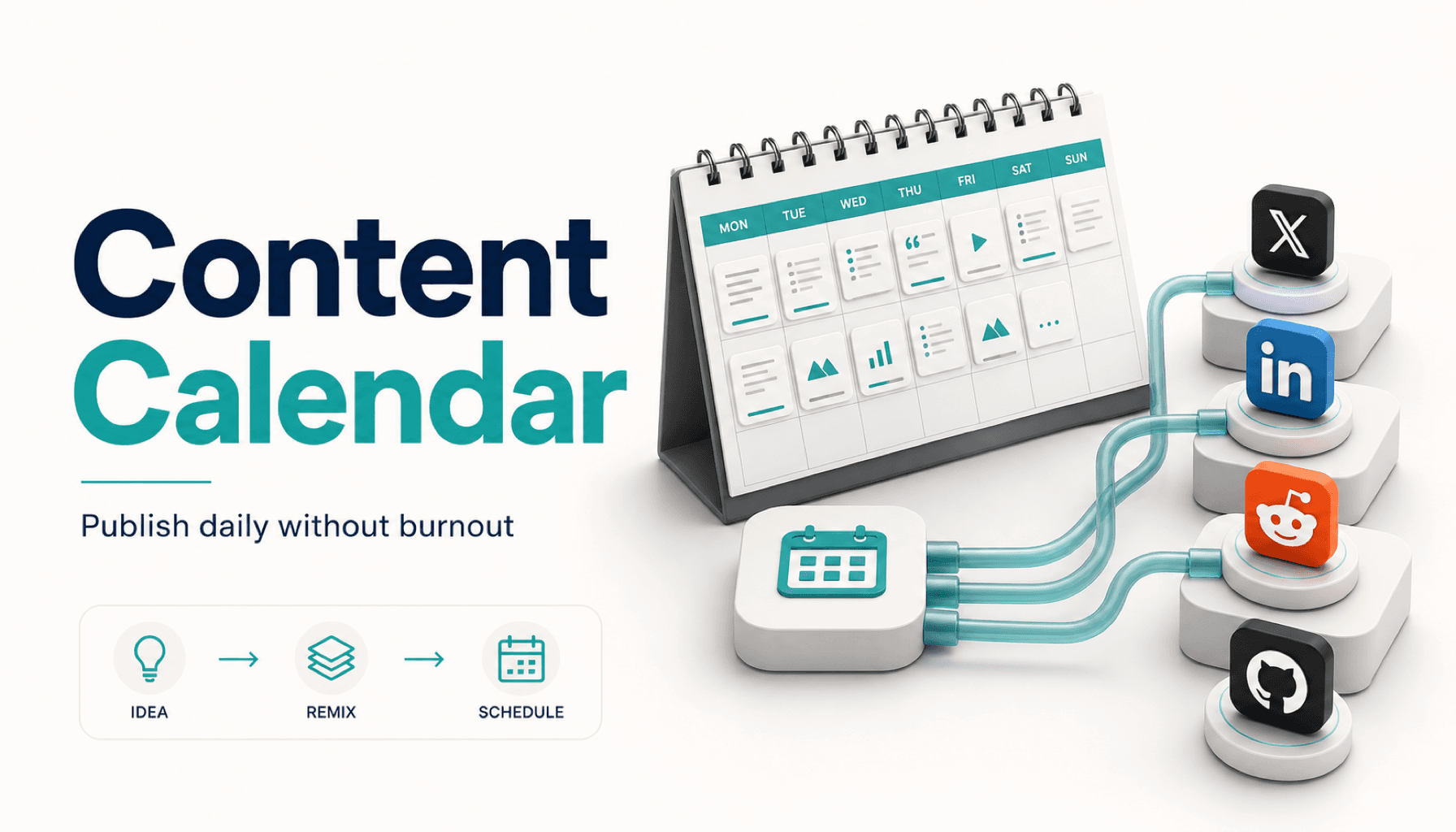
This guide is for the founder who needs a content operation that doesn't require a full-time content person. The target is sustainable daily presence on four platforms — X, LinkedIn, Reddit, and GitHub — with a weekly time investment you can actually protect.
Why Most Content Calendars Fail for Solo Founders
The classic content calendar has slots for blog posts, social captions, video scripts, newsletters, and platform-specific rewrites — all color-coded, all cross-referenced. It works for a five-person marketing team. For a solo founder, it fails in week two.
The failure modes are predictable. First, the calendar requires more decisions per post than you have mental bandwidth for. Every empty slot is a question you have to answer under pressure: what do I say, who is it for, which format, what CTA? Second, it treats each platform as a separate content project, multiplying your workload by four instead of amortizing it across one idea. Third, it front-loads the work — you're supposed to plan a month ahead, but your product, your customers, and your thinking evolve week to week.
The problem isn't consistency. Founders who talk to customers daily have no shortage of things to say. The problem is extraction cost — the gap between having an insight and turning it into five platform-ready pieces of content.
The fix is a content system built around your actual constraint: a single block of focused time per week, one idea as the atomic unit, and a clear derivation path from that idea to everything else. Complexity lives in the system, not in your head.
The Minimal Viable Content Calendar: One Idea, Four Platforms
The core principle is input minimization. You have one job: generate one substantive idea per week. Everything else is derivation.
A "substantive idea" is narrower than it sounds. It's not a topic. It's a claim with a reason. "LinkedIn posting is underrated for B2B SaaS" is a topic. "I got three enterprise leads from one LinkedIn post about a bug fix, and here's why that happened" is a claim with a reason. The specificity does the work — it gives you natural structure, evidence, and a point of view you can defend.
From that one idea, you derive:
- An X thread — the argument unpacked in 6-8 tweets, hook first
- A LinkedIn post — the story version, 150-300 words, first-person narrative
- Two or three Reddit comments — the useful fragment, dropped into relevant threads where this exact insight is what the community needs
- A GitHub README or issue note — if the idea touches your product, document it where developers will find it
This is not four separate content pieces. It's one idea expressed in four registers. The thinking happens once. The adaptation takes 20 minutes per platform once you've done it a few times.
Platform-Specific Formats That Actually Perform
Each platform has a native format that outperforms everything else. Knowing this saves you from writing LinkedIn posts that read like tweets, or Reddit comments that read like ads.
X Threads
Threads work when they teach something you'd normally need to read a blog post to learn. The structure: hook tweet (the counterintuitive claim or the result), 5-6 body tweets (the evidence, the steps, the nuance), final tweet (the takeaway or the offer). The hook is 80% of your reach. Write it last, after you know what the thread actually proves. Keep each tweet completable — a reader who stops at tweet 3 should still have learned something.
LinkedIn Posts
LinkedIn's algorithm rewards dwell time and saves, not just likes. Long-form narrative outperforms short takes. The format that works: three-line hook that creates a gap the reader needs to close, story that earns the insight, insight stated plainly, one-sentence CTA that invites a reply. No bullet lists in the first three lines. The "See more" fold is your hook's only job.
Reddit Comments
Reddit is not a broadcast channel. It's a search engine with a community layer. The play is finding threads where your experience is the exact answer to the question being asked, then answering it completely — no pitch, no link until it's earned. One well-placed comment in r/SaaS or r/entrepreneurship can outperform a week of LinkedIn posts in terms of qualified traffic.
GitHub READMEs and Issue Notes
Developers trust GitHub because it's where real work happens. If your product has a technical dimension, your GitHub presence is content marketing that never decays. Document your decisions, write honest changelogs, answer issues with explanations that could help the next person searching the same error. This compounds over months.
The Content Repurposing Flywheel: One Week of Content from One Piece of Work
The flywheel starts with something you already did — a customer call, a product decision, a bug that took four hours to fix, a metric that moved. You're not generating ideas from nothing. You're extracting signal from work you've already done.
Here's a concrete example. You spend Tuesday fixing a rate limiting issue on your API. That's the seed. The derivation:
- Day 1 (X thread): "I just spent 4 hours on a rate limiting bug that was actually a caching problem. Here's what I learned." — 6 tweets, technical, specific
- Day 2 (LinkedIn): The same story, reframed as a lesson about debugging assumptions — narrative, slightly more personal, ends with a question to your network
- Day 3 (Reddit): Find a thread in r/webdev or r/devops where someone is hitting a similar issue. Drop your solution as a comment. No self-promotion.
- Day 4 (X, standalone tweet): The one-liner insight extracted from the thread — "Caching bugs always look like rate limiting bugs until you've seen enough of both."
- Day 5 (LinkedIn, follow-up): Responses to comments on the Monday post, plus a short update if the fix led to anything new
- Day 6 (GitHub): Update the README with a note about the rate limiting behavior, or write it up in a discussion post
- Day 7: Nothing, or a repost of the X thread for a different timezone audience
You did one thing. You extracted seven touchpoints from it. The flywheel spins because the content is grounded in real work — it's credible, specific, and useful in a way that purely manufactured content never is.
Batch Writing vs. Real-Time Posting: What Actually Works for Founders
There are two schools. Batch writers block three hours on Sunday and write everything for the week. Real-time posters capture and publish in the moment. Both have failure modes.
Batch writing fails when your week goes sideways — the content you wrote doesn't reflect what actually happened, and you end up posting stale ideas while something more interesting is happening in real time. It also requires sustained creative output when you might not be in a generative state.
Real-time posting fails because it's cognitively expensive at the wrong moments. You're in the middle of building something, and context-switching to write a LinkedIn post from scratch costs more than the post is worth. It also produces uneven output — great posts when you're energized, nothing when you're in the weeds.
The hybrid that works: capture in real time, write in batches. Keep a running note — a Notion doc, a voice memo app, a Slack message to yourself — of anything interesting that happens during the week. On Thursday or Friday, spend 45 minutes turning those captures into drafts. Queue them for the following week. You're writing from material, not from nothing, and the writing session has a defined end.
The goal is to separate the observation from the publication. Founders who capture well never run out of material. The bottleneck is always extraction, not generation.
Using AICMOHQ to Automate the Calendar: How the Publisher Agent Works
The manual version of this system works. It's about 90 minutes per week if you're disciplined. But there's a meaningful category of work that a tool can do without adding decision cost — and that's where AICMOHQ fits.
The Scout agent monitors Reddit, X, LinkedIn, and Hacker News for threads relevant to your product and ICP. When it finds a thread where your experience is directly applicable, it surfaces it — not as a raw feed you have to process, but as a specific opportunity with context: this thread, this reason, this is what you'd say. You decide whether to engage. The finding work is automated.
The Writer agent drafts in your voice. You give it the seed — the idea, the capture, the rough point — and it produces platform-ready variations: thread structure for X, narrative arc for LinkedIn, comment draft for Reddit. The draft is a starting point, not a final product. Most founders edit it down to 70% of the original. That's still a 70% reduction in blank-page time.
The Publisher agent handles scheduling and posting. It knows each platform's optimal posting window, manages the queue, and handles the mechanical work of publishing. For X, it splits threads correctly. For LinkedIn, it formats for the algorithm. You review the queue once a week and approve or edit what's in it.
The combination means the work that actually requires your judgment — what's worth saying, what's true about your product, what your customers care about — stays with you. The work that doesn't require your judgment gets automated.
The Approve-and-Forget Workflow: 15 Minutes Per Week on Content
Here's what the optimized weekly workflow looks like with AICMOHQ in the loop:
- Monday morning, 5 minutes: Review the Scout feed. Flag two or three Reddit or X threads worth engaging with. Dismiss the rest.
- Thursday, 10 minutes: Open the content queue. AICMOHQ has drafted posts based on your captures and the opportunities Scout found. Edit what needs editing, approve what's good, kill what isn't. Done.
The posts go out on schedule. Replies from Engage come through as notifications when something needs your actual response — not every reply, just the ones that are real conversations. The Analyst agent surfaces what performed well and why, once a week, as a brief you can read in two minutes.
The 15-minute number is real, not aspirational marketing copy. It's 15 minutes because the system is built around the constraint. AICMOHQ's default mode is approve-before-publish — nothing goes out without your review. You keep creative control. You just don't spend time on logistics.
What makes this sustainable is the asymmetry: a 15-minute weekly commitment produces daily presence on four platforms. That ratio is only possible because the system eliminates decision overhead, not because you've lowered your standards.
Tracking What Works: Metrics That Matter for Early-Stage Founders
Most content analytics tell you things that feel meaningful but aren't actionable: impressions, follower count, engagement rate. For an early-stage founder, one metric matters more than all of them: did this content create a conversation with someone who could become a customer?
That's it. Everything else is a proxy.
In practice, you're watching for:
- DMs and replies that mention your product — someone who found you through a Reddit comment and wants to know more
- Profile visits from posts — especially for LinkedIn, where a spike in profile views after a post means the content landed with the right people
- Comment quality on X threads — are the people replying people you'd want as customers? Not bots, not generic "great post" comments, but people with the specific problem your product solves
- Reddit referral traffic — trackable in GA4 or in AICMOHQ's Analyst agent output; a good Reddit comment that links back drives qualified traffic for months
At early stage, vanity metrics actively mislead you. A thread that gets 50,000 impressions from a viral hook but zero conversations is worth less than a LinkedIn post that reaches 400 people and gets seven DMs from your target customer. Optimize for signal, not scale.
AICMOHQ's Analyst agent tracks engagement at the content level and surfaces the ICP signal in those numbers — which posts led to profile visits from people who match your ICP, which threads generated replies from potential customers versus general audience. It's not a replacement for reading your own replies, but it removes the part where you have to dig through a spreadsheet to notice the pattern.
Review your content performance monthly, not weekly. Weekly is too noisy. Monthly gives you enough data to see what's actually working — which formats, which topics, which platforms are producing conversations with the right people. Adjust the following month's input accordingly. This is a slow loop, and it should be. Content compounds over quarters, not days.
Ready to Automate Your Marketing?
You don't need a content team. You need a system that fits your actual constraints — one idea per week, 15 minutes of review time, and automation handling the rest. AICMOHQ is built specifically for solo founders who are serious about marketing but can't afford to make it a full-time job. Scout finds the opportunities, Writer drafts in your voice, Publisher handles the scheduling, and you stay in control of everything that goes out. Start your AICMOHQ trial — credit card required, and you'll have your first week of content queued in under an hour.