TACTICAL
Full Marketing Strategy as a Solo Founder: How to Market Without Hiring Anyone
Most solo founders face a version of the same trap: they shipped something real, a handful of people use it, and now they need to grow — but every hour spent on marketing is an hour not spent on the product. The advice they read assumes a team. "Post daily on LinkedIn." "Run retargeting ads." "Publish two SEO posts a week." None of it accounts for the constraint: there is one of you.
The good news is that marketing at the solo stage is actually a solvable coordination problem. The mistake is treating it like a creativity problem — obsessing over messaging and positioning before you have a repeatable way to show up. Get the system right first. The creativity follows.
This is the full breakdown: what to do at each stage of growth, how to build a system that runs on one hour a week, and where automation earns its place.
The Fundamental Problem: You Can Code or Market, Rarely Both
The reason most solo founders stall at 50–200 users is not product quality. It is attention allocation. Coding and marketing require completely different cognitive modes. Coding is deep, focused, long-session work. Marketing — at least the kind most founders attempt — is shallow, reactive, and fragmented: checking replies, writing threads, tweaking copy, responding to comments.
Switching between them constantly destroys both. You end up with half-built features and half-hearted marketing — the worst of both worlds.
The solution is not to do less marketing. It is to architect marketing so it stops demanding constant attention. That means:
- Batch creative work into single sessions (one afternoon a week, not scattered throughout every day)
- Automate distribution and engagement so the work compounds without ongoing input
- Match marketing intensity to your current stage — don't build infrastructure for 10,000 users when you have 30
The biggest waste I see is founders who try to run a full content marketing program at 20 users. SEO takes six months to pay off. A newsletter with 40 subscribers returns almost nothing. At that stage, every hour on "content strategy" is an hour not talking to someone who might actually buy.
Stage-matching is the core discipline. The right marketing at the wrong stage is wasted effort.
The Three Marketing Modes: Match Strategy to Stage
Think of your marketing evolution in three distinct modes, each with a different primary lever:
Mode 1: Manual (0–10 users)
At this stage, your job is not to scale anything — it is to find the ten people who genuinely benefit from what you built and understand why. Everything is direct and personal. You are looking for signal, not volume. Marketing at this stage is really sales: direct outreach, real conversations, watching how people actually describe the problem you solve. The language you hear from these first ten users becomes the copy that works later.
Mode 2: Hybrid (10–100 users)
You have some evidence the product works. Now you build the content layer on top of what you learned in Mode 1. You are still doing manual things — but you are also starting to produce content that brings people to you, rather than chasing them down. SEO seeds are planted here even though they won't pay off for months. Build-in-public starts here. This mode has the most work-per-user but builds the durable assets that power Mode 3.
Mode 3: Automated (100+ users)
You have enough data to know which channels convert, which content performs, and what your ICP looks like in behavioral terms. This is where you replace manual labor with intelligent automation. Not "set it and forget it" automation — approve-first automation, where you review before anything goes out. The goal is to go from spending 10 hours a week on marketing to spending 1 hour reviewing and approving work the system prepared.
Most founders try to skip to Mode 3 before they have the data that makes automation meaningful. Resist it. The automation is only as good as the training data — your early manual work is that training data.
Phase 1: Manual Outreach (The Right Way)
Manual outreach has a bad reputation because most people do it badly. They blast generic messages, post promotional content in subreddits, and wonder why no one responds. The right approach is almost embarrassingly simple: be genuinely useful in public, then follow up privately.
Find the three or four subreddits where your ICP lives. Not to post about your product — to answer questions. Spend 30 minutes a day for two weeks doing nothing but writing genuinely helpful replies to problems your product solves. No links. No mentions of your tool. Just the answer. After a few weeks you will have a reputation in the subreddit as someone who knows the topic. Then, and only then, do you post something like "I kept answering this question manually, so I built a tool. Here's what it does." The conversion rate on that post versus a cold promotional post is not even comparable.
Hacker News Show HN
Show HN is one of the most underused launch channels for solo founders. The audience is technical, curious, and willing to try new things. The formula: lead with what the product does (not what it is), include a live demo link, be in the comments for the first two hours responding to every question. A mediocre Show HN with active founder engagement outperforms a well-written one with no follow-through. The comments are the product demo.
Direct DMs
LinkedIn DMs and Twitter DMs work when they are specific and relevant. Find people who have publicly talked about the problem you solve — a tweet complaining about the exact thing your product fixes, a LinkedIn post describing a workflow you automate. Reach out referencing that specific post. "I saw you posted about X last week. I built something that handles that. Happy to share if useful." Three sentences. A clear offer. No pitch deck attached.
The goal of Phase 1 is not users — it is conversations. Every conversation either confirms your ICP or updates it. Both outcomes are valuable.
Phase 2: Content-Led Growth
Once you have talked to enough people to know who your ICP is and how they describe their problem, you can start building content that brings them to you. Content-led growth at the solo stage means three things: ICP-specific articles, build-in-public, and SEO that is actually useful.
ICP Content
Write the content your ICP is searching for, not the content you want to write. The gap between these is usually large. You want to write about your product's features. Your ICP is searching for solutions to specific workflow problems. The article that ranks and converts is the one that helps someone solve a real problem — and mentions your product as one possible solution among an honest assessment of the options.
This means your best-performing content will often not be directly promotional. A guide titled "How to find leads on Reddit without getting banned" will bring more qualified users to an outreach tool than "The best outreach tool for founders." Write the honest guide, do it better than anyone else has, and trust that people who read it will look at what you built.
Build in Public
Build-in-public is not a growth hack. Done right, it is a public record of your thinking — what you tried, what failed, what surprised you — that compounds into an audience of people who trust your judgment. The mistake is building in public as performance: follower counts, revenue graphs, "big announcement" threads. That stuff has a short shelf life.
The version that works long-term is honest and specific. "I spent three days on a feature nobody asked for. Here's what I learned about scoping." "Our churn this month was 12%. Here's the three conversations that explained it." That kind of content attracts exactly the right audience — people who are building something similar and find your specific experience useful.
SEO
At the solo stage, SEO is a seed crop, not a harvest. Plant it in Phase 2 because the 6-month lag means you need it growing before you need it working. The practical approach: identify 10-15 longtail keywords your ICP searches, write one genuinely excellent post per keyword, and update the best-performing ones every few months. You don't need 100 posts — you need 15 posts that are the best answer to 15 specific questions.
Phase 3: Autonomous Marketing
By the time you reach 100+ users, you have real data: you know which platforms your users come from, what content they engage with, what their job titles are, what they complain about. This is when automation stops being wishful thinking and starts being genuinely useful.
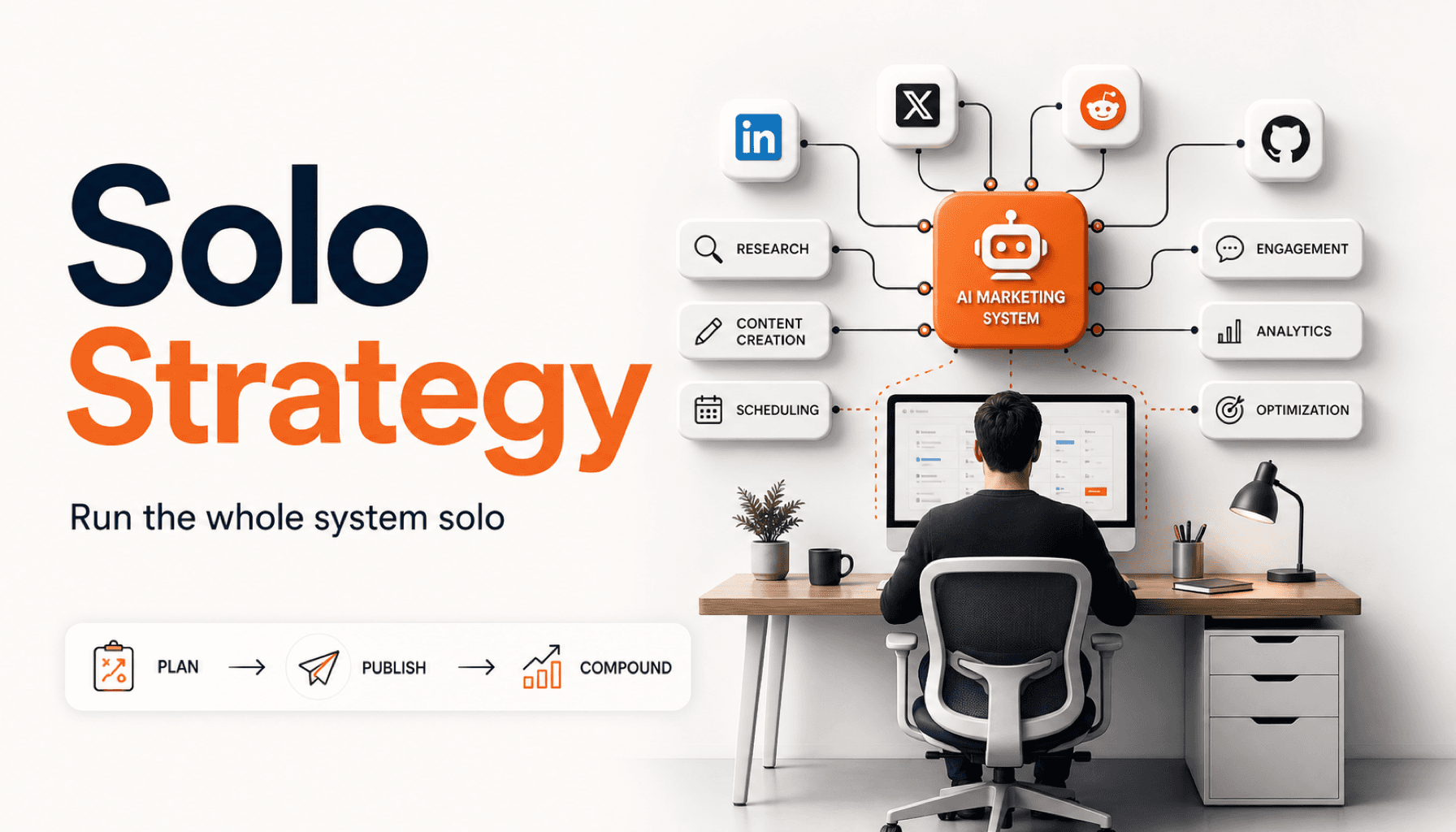
Autonomous marketing does not mean unsupervised marketing. The best model is approve-first: the system does the research and drafting, you review and approve, it publishes and engages. This is exactly how AICMOHQ is designed to work — the Scout agent surfaces opportunities on Reddit, X, LinkedIn, and HN; the Writer drafts in your voice; you review in a single queue; Publisher posts on schedule; Engage handles replies; Analyst reports back on what worked.
The key word is "in your voice." Autonomous marketing that sounds like it came from a bot destroys trust faster than silence. The system needs to be trained on your actual writing — real posts, real replies, real emails — before it can draft credibly on your behalf. This is why Phase 2 matters: you are creating the training corpus for Phase 3.
The goal of Phase 3 is not to replace your judgment — it is to apply your judgment at 10x the surface area without 10x the time.
With an automated system in place, a founder who spent 8 hours a week on marketing in Phase 2 can cover the same ground in 45 minutes of review and approval. The reclaimed time goes back into product, customer success, and the occasional deep-dive that the system flags as worth personal attention.
The One-Hour-Per-Week Marketing System
Once you are in Phase 3, the weekly marketing session looks like this:
- Review the opportunity queue (15 min): The Scout agent has surfaced relevant Reddit threads, X conversations, and LinkedIn posts where your ICP is active. You scan them and mark which ones to engage with. Maybe 8-12 items per week.
- Approve drafted responses (15 min): The Writer has already drafted replies for the items you flagged. You read each one, edit where the voice is off or the answer isn't quite right, approve the rest. Most take 30 seconds. Occasionally one needs a full rewrite — do that yourself, it becomes training data.
- Review content calendar (10 min): Check what is scheduled for the week. Approve, reschedule, or pull anything that feels off given current context (a news event, a product update, a customer complaint that changes the tone).
- Read the analytics report (5 min): What got engagement? What converted? Any outlier posts worth doubling down on? The Analyst agent compiles this into a one-page summary. You make one or two decisions based on it.
- One open slot (15 min): This is unscheduled time for whatever the system can't handle — a thought you want to post raw, a reply to a high-profile thread, a founder DM that needs a personal touch. Some weeks you won't use it. Keep it anyway.
Total: roughly 60 minutes. The rest of the week, the system runs.
This only works if Phase 1 and Phase 2 were done properly. The system is amplifying judgment, not replacing it. If the judgment was never developed — if you never had the real conversations, never wrote the manual content, never learned your ICP well — the automation produces competent noise instead of genuine value.
How AICMOHQ Fits Into Each Phase
The honest answer is that AICMOHQ is most powerful in Phase 3, useful in Phase 2, and peripheral in Phase 1. Here is how to think about it at each stage:
| Phase | Primary Use | Which Agents |
|---|---|---|
| Phase 1 (0–10 users) | ICP Validator to test your assumptions about who you're building for; Scout to monitor where your ICP actually hangs out | Scout, ICP Validator |
| Phase 2 (10–100 users) | Writer to draft content faster, Analyst to track what resonates, Publisher to maintain consistent scheduling | Writer, Publisher, Analyst |
| Phase 3 (100+ users) | Full agent stack running in approve-first mode; the one-hour-per-week system | All six agents |
During the 7-day trial, you can run enough Scout + ICP Validator queries to validate your ICP assumptions before you spend a single hour on content. That alone is worth the signup. The Pro plan ($49/month, 2,000 credits) covers a full active Phase 3 operation — all six agents, all channels, weekly approve cycles — with room to spare.
The ICP Validator is the most underrated feature for early-stage founders. Most founders think they know their ICP. Most are wrong in specific ways they can not see until they stress-test the assumption with real data. Run the validator before you write a single piece of content — it will change what you write.
The Tools Stack Beyond AICMOHQ
No single tool covers everything. Here is the minimal stack that works for a solo founder operating across all three phases:
Listening and Research
- Reddit search + F5Bot: F5Bot sends you an email when your keywords appear in new Reddit posts. No setup, runs in the background. Invaluable for Phase 1 manual outreach.
- Feedly or Inoreader: RSS-based aggregation for industry blogs. Set up once, check weekly. Not glamorous but reliable.
- SparkToro: If you have budget, SparkToro tells you exactly where your audience reads and who they follow. Replaces months of manual research.
Writing and Production
- Obsidian or Notion: Keep a running "content ideas" note that you add to throughout the week — one-line ideas, interesting conversations, questions you keep getting asked. Your weekly session pulls from this.
- Hemingway App: Paste your drafted posts before publishing. Forces you to cut the qualifiers and nominalisations that make founder writing sound corporate.
Distribution and Scheduling
- AICMOHQ Publisher: Handles X, LinkedIn, and Reddit in a single queue with approve-first workflow.
- Beehiiv or Substack: For newsletter, if you run one. Both have decent starter tiers. Substack has built-in discovery; Beehiiv has better analytics.
Analytics
- Plausible or Fathom: Lightweight, privacy-respecting web analytics. You need to know which channels send traffic that converts — these are simpler to act on than GA4.
- AICMOHQ Analyst: Cross-channel performance rolled up into a single weekly summary. Saves the tab-switching between platform dashboards.
- Ahrefs Webmaster Tools (no-cost): Track keyword rankings for your SEO content. The starter tier covers what a solo founder needs in Phase 2.
Keep the stack small. Every tool you add is a tab to check and a dashboard to maintain. The overhead compounds. If you are spending more time maintaining your marketing stack than producing marketing output, cut tools until the ratio inverts.
Ready to Automate Your Marketing?
The system described here — three phases, stage-matched tactics, one-hour-per-week execution — is not theoretical. It is the architecture that works when you are the only person doing marketing. Phase 1 builds the judgment. Phase 2 builds the assets. Phase 3 puts it on autopilot with you in the approval seat.
AICMOHQ was built specifically for this workflow: six AI agents that cover Scout, Writer, Publisher, Engage, Analyst, and ICP Validator — all running in approve-first mode so you stay in control without staying in the weeds. Connect your X, LinkedIn, Reddit, and GitHub accounts, run the ICP Validator first, and let the system do the research and drafting while you review once a week.
You can start with AICMOHQ and see how the agents work before the first charge. If it fits the way you actually work, Pro is $49/month — less than most founders spend on tools they check once and forget.
Start your AICMOHQ trial — credit card required. Connect your accounts, run Scout, and see what it surfaces in the first 10 minutes.