AUDIENCE
Autonomous Marketing vs Social Media Scheduling: Why They're Not the Same Thing
At some point every founder who runs their own marketing makes the same mistake: they set up a scheduling tool, fill it with two weeks of posts, and feel like they've solved marketing. The queue is full. The week is handled. Time to focus on the product.
Then the analytics come in. Impressions are fine. Engagement is tepid. Nobody clicked through. No deals started because of it. And because the posts were written in a single session, they all sound the same — slightly formal, slightly trying-too-hard, disconnected from whatever was actually happening in the market that week.
This isn't a failure of discipline. It's a category error. Scheduling and autonomous marketing solve different problems entirely. Conflating them is like thinking a well-organized inbox is the same as a sales process. Both involve email. That's where the similarity ends.
The Scheduling Trap: Why Filling a Queue Isn't a Strategy
Scheduling tools were built around a specific workflow: a human produces content in batches, and the tool distributes that content over time. Buffer, Hootsuite, Later, Typefully — they're all elegant execution layers on top of a fundamentally manual content production process.
The trap isn't the tool itself. The trap is the mental model it creates. Once you have a full queue, it feels like marketing is happening. And in a narrow sense, it is — posts are going out, boxes are getting checked, the calendar looks active. But scheduling is a delivery mechanism, not a discovery mechanism. It moves content from your drafts folder to the world. It does nothing to help you figure out:
- What your audience is actually talking about this week
- Which pain points are surfacing in their communities right now
- Where your message lands and where it dies
- What angle on your product drives action vs. generates silence
- Who commented, what they said, and whether a reply would warm a lead
A scheduled post from three Tuesdays ago hits someone's feed today, blissfully unaware that the news cycle, a competitor's launch, or a shift in community sentiment has changed what your audience needs to hear. You're not in conversation. You're broadcasting into a void on a timer.
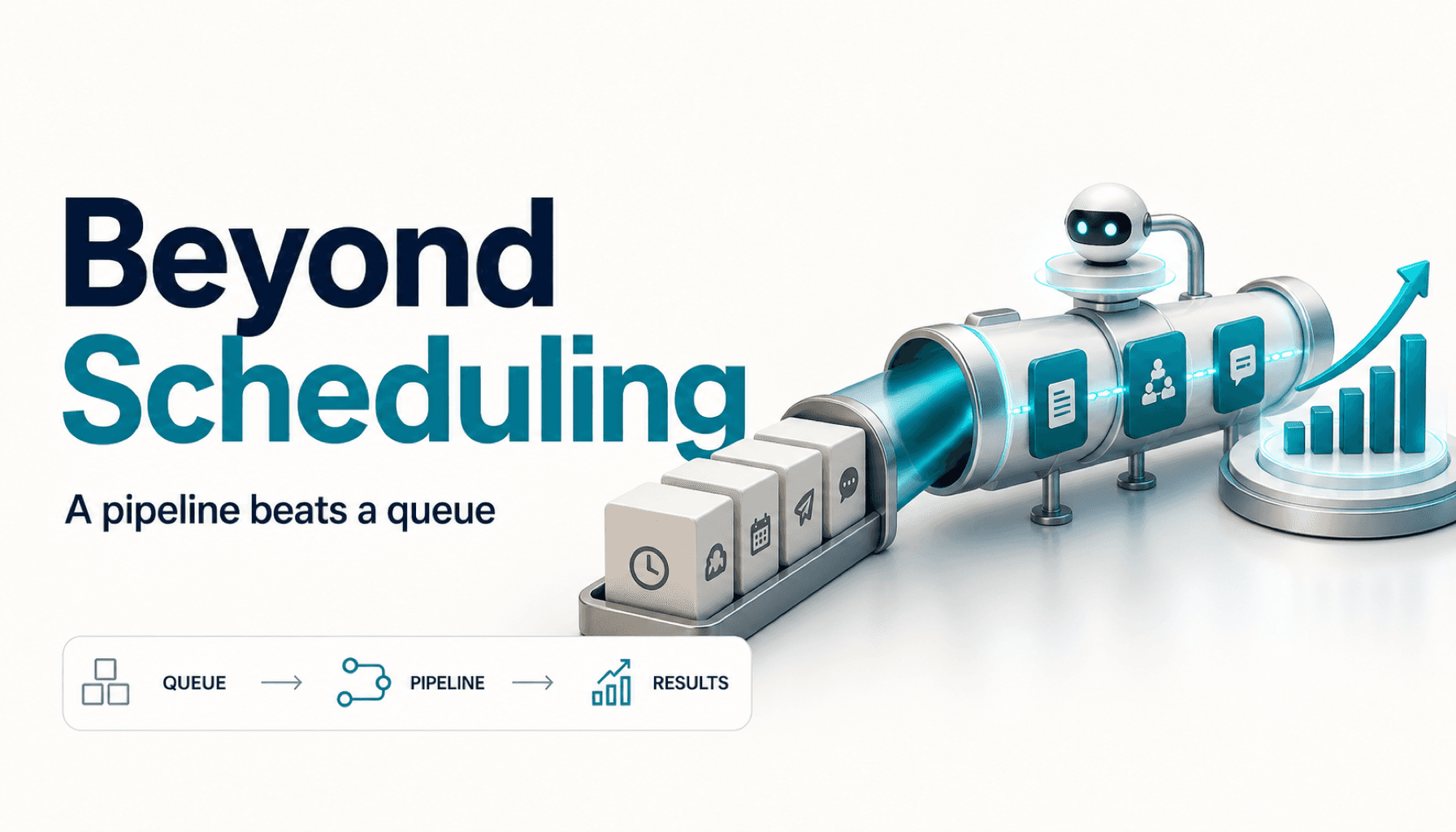
Scheduling automates distribution. Autonomous marketing automates intelligence. These are not the same operation.
The deeper problem is that batch content creation produces batch-quality content. When you sit down to write 10 posts in a session, you're not doing research for each one — you're pattern-matching to what worked before and filling the calendar. The result is content that's technically consistent but strategically stale before it ever publishes.
What Scheduling Tools Actually Do — and the Gap They Leave
Let's be fair to the scheduling category. These tools do genuinely useful things. Buffer's queue management is clean. Typefully's thread composer is excellent for X/Twitter. Hootsuite's multi-account dashboard is real value for agencies managing a dozen clients. Later's visual Instagram planner solves a specific problem well. None of this is being dismissed.
But look at what they all share: the workflow begins with you. Every piece of content they publish originated from a human session. The tool schedules, but it does not research. It queues, but it does not observe. It publishes, but it does not learn.
| Capability | Scheduling Tools | Autonomous Marketing AI |
|---|---|---|
| Queue management | Yes | Yes |
| Multi-platform publishing | Yes | Yes |
| Market / community research | No | Yes |
| Content drafting | No | Yes |
| Voice matching | No | Yes (learns over time) |
| Engagement handling | No | Yes |
| Performance learning loop | Basic analytics | Feedback into future content |
| ICP signal detection | No | Yes |
The gap scheduling tools leave is the entire upstream of marketing: listening, researching, positioning, drafting, and refining based on what worked. Everything before the publish button. That's not a small gap — it's the majority of the work. Scheduling tools assume a competent content machine already exists and simply help its output reach the world. Most solo founders don't have a content machine. They have themselves, a full product roadmap, and limited hours.
What Autonomous Marketing Does Differently
Autonomous marketing starts before a single word is written. It begins with observation: scanning communities, subreddits, LinkedIn comment threads, X replies, HackerNews threads, competitor mentions — looking for signals. What are people complaining about? What questions keep appearing? What framing seems to resonate when someone else posts about an adjacent topic?
This research phase is what makes the content that follows fundamentally different from scheduled batch content. When a post is grounded in something that's actually happening in the market right now, it doesn't just distribute a message — it enters a conversation. That's the difference between a post that gets 8 impressions and 0 clicks and one that generates a reply thread, a DM, or a lead.
After research comes drafting — but not in your voice from a template. Autonomous marketing systems learn how you write: your sentence structure, your word choices, your level of formality, the kinds of analogies you reach for, how you phrase technical concepts. The output isn't generic AI copy. Over time, it's a draft you'd be embarrassed to admit you didn't write yourself.
Then comes the engagement layer. A post that goes out and gets a comment from someone who sounds like your ideal customer — that's a warm lead. Most scheduled content workflows have no answer for this. It happens, you don't see it for days, and by then the moment has passed. Autonomous marketing monitors, flags, and in many cases responds — with a reply drafted in your voice that keeps the conversation moving.
Finally, everything feeds back. Which posts drove traffic? Which got engagement? Which fell flat despite strong reach? These signals shape what gets researched and drafted next. The system gets more accurate about what works as it accumulates data about your specific audience and positioning. Scheduling tools don't do this. They have no memory of what worked. Next month's queue starts from scratch.
The 5 Stages of the Autonomous Marketing Loop
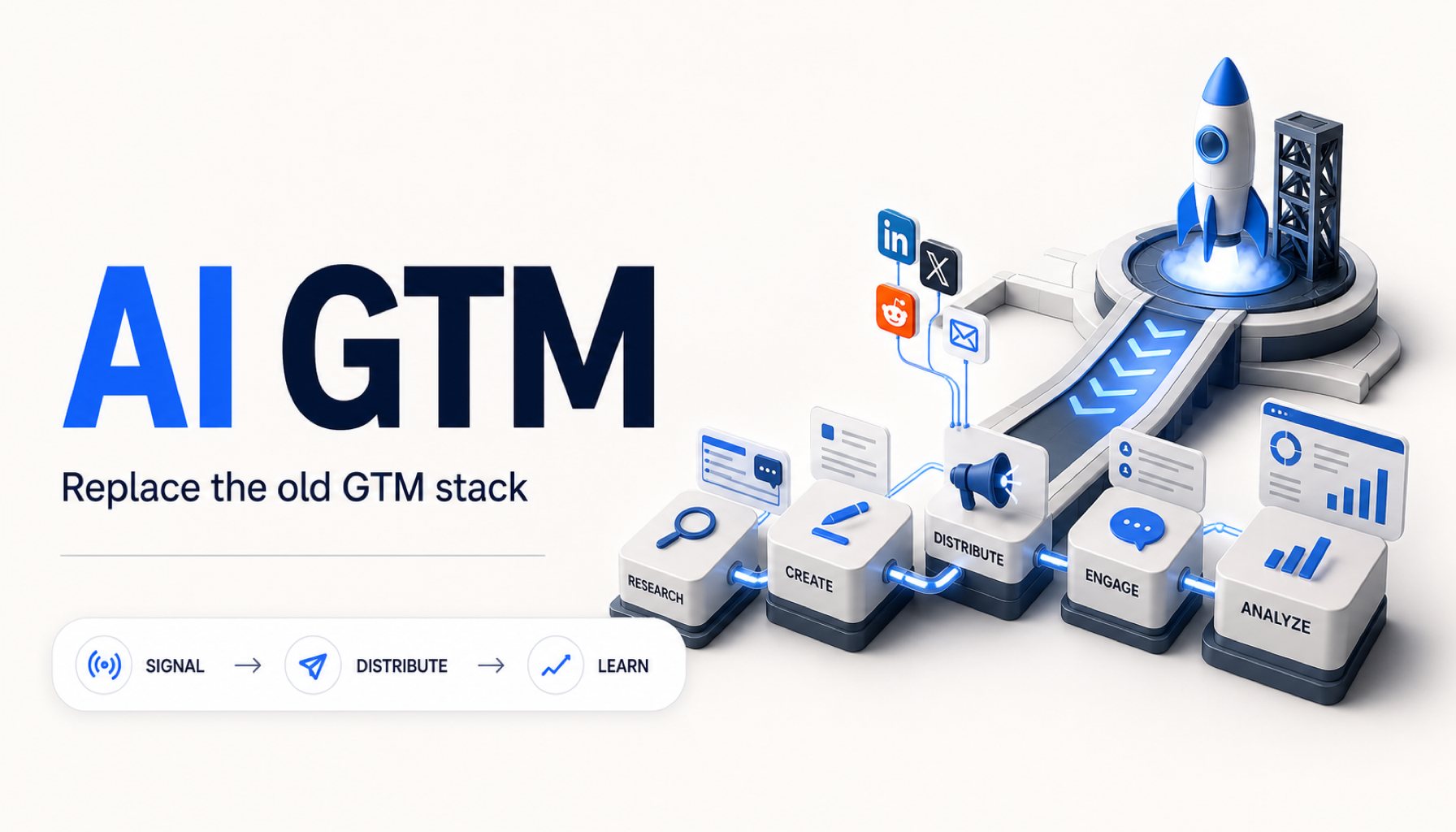
The most useful way to understand autonomous marketing is as a closed loop — not a one-way pipeline from creation to publication, but a cycle where each stage informs the next. Here's how it runs:
- Scout: AI agents scan Reddit, X, LinkedIn, HackerNews, and other sources for signals — trending discussions, recurring pain points, competitor mentions, questions your ideal customer is asking. This runs continuously, not in weekly batch sessions.
- Write: Relevant signals get turned into content drafts. Not generic content — drafts that reference the specific conversation, take a position, and are written in the founder's voice. The framing comes from the research; the draft comes from the voice model built on your past content.
- Publish: Drafts move through the queue with scheduling logic: right platform, right time, right format. Twitter threads, LinkedIn long-form, Reddit replies — each handled with platform-appropriate formatting rather than one post duplicated everywhere.
- Engage: Comments, replies, and DMs are monitored. High-signal responses — especially from people who match your ICP — get flagged for follow-up or handled with a drafted reply that keeps the conversation active.
- Analyze: Performance data (reach, engagement, clicks, conversions) is fed back into the Scout and Write stages. Posts that drove actual outcomes get weighted more heavily than posts that got impressions. The system learns what works, not just what got seen.
This loop is self-reinforcing. The longer it runs, the better calibrated it becomes to your audience, your positioning, and the platforms you're on. Scheduling tools have no equivalent mechanism — they're stateless. Each month starts from zero.
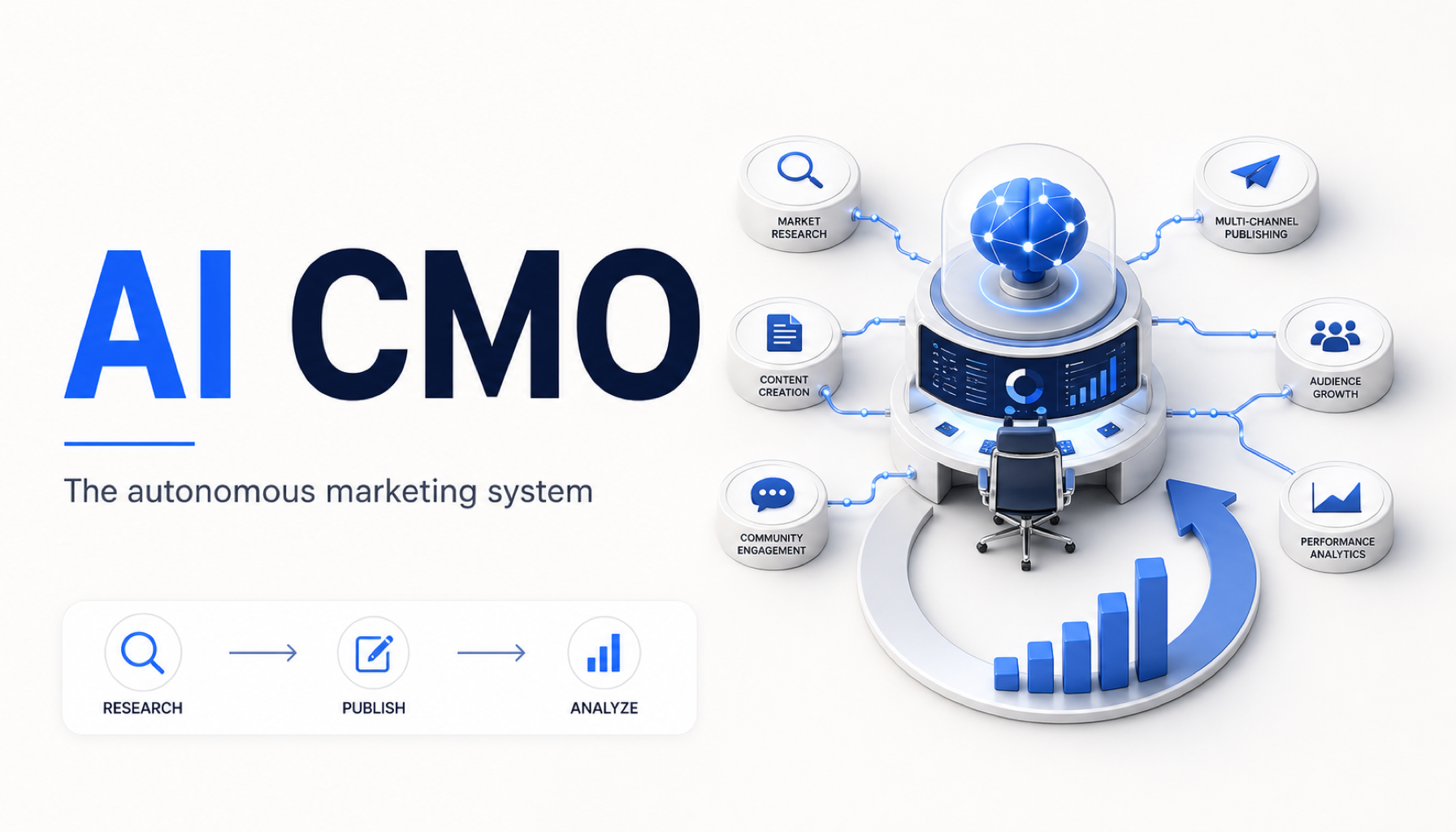
Platforms like AICMOHQ are built around exactly this loop: Scout, Writer, Publisher, Engage, and Analyst agents working in sequence, with an ICP Validator layered in to help you understand whether the audience you're actually reaching matches the one you're trying to build.
Why Approval-First Autonomy Matters
Here's the risk nobody talks about when selling autonomous marketing: fully autonomous posting is genuinely dangerous for most founders.
Your brand voice is more fragile than you think. One off-message post — something that's technically in your topic area but takes a position you'd never actually take, or references something in a way that reads wrong — can cost you credibility that took months to build. This is especially true in niche B2B markets where your audience is small and paying close attention.
AI systems can research well and draft plausibly, but they can't fully model your professional risk tolerance, your relationship with specific community members, or the unwritten rules of your market. They can get close. They can't get there without you in the loop.
The right model for most founders is approval-first autonomy: the system does the research, writes the draft, formats it correctly, schedules it — and then surfaces it to you for a single yes/no before it posts. This collapses the time investment from "write from scratch" to "review and approve" — often 30 seconds per post instead of 30 minutes — while keeping you in control of what goes out under your name.
This is the default in AICMOHQ: the platform's agent mode is set to approve unless you explicitly switch it. Nothing posts without your sign-off. You keep the speed benefits of automation without the brand risk of fully autonomous publishing. For founders who've tested the system and trust it for specific content types, autonomous mode is available — but approval-first is the right starting point for nearly everyone.
The goal isn't to remove yourself from marketing. It's to remove yourself from the parts of marketing that don't require you — leaving more time for the parts that do.
The Compounding Effect: Why Autonomous Marketing Gets Better Over Time
Scheduling tools plateau. Once you've figured out the best time to post and the format that works for your platform, there's not much more to optimize. You're still writing from scratch every week. The tool just handles the when and where.
Autonomous marketing compounds. Every piece of content that goes out teaches the system something. Every engagement signal refines the model. Every high-performing post shifts the distribution toward content that looks more like it. After six months of running an autonomous marketing loop, the quality of research, drafts, and targeting should be meaningfully better than it was on day one — because the system has learned from a real body of work in your voice, in your market, with your audience.
This compounding is the real reason the category matters. The ROI on scheduling tools is roughly flat over time: you invest N hours per week producing content, and the tool distributes it. The ROI on autonomous marketing should increase over time as the system becomes better calibrated. Month three should be more efficient than month one. Month six should be better than month three.
The compounding also shows up in a less obvious place: community trust. When you're consistently present in the conversations your audience is having — because the system is monitoring those conversations and helping you respond — you become a recognized voice over time. That presence is hard to buy and easy to miss if you're only broadcasting on a timer.
When to Use Scheduling vs Autonomous Marketing
This isn't an all-or-nothing choice. There are real scenarios where a scheduling tool is the right answer, and real scenarios where it isn't enough. Here's a direct map:
Use a scheduling tool when:
- You have a strong, established content production process and just need reliable distribution
- You're managing social for a brand with a large content team where production is already handled
- Your content is primarily evergreen and doesn't need to respond to real-time signals
- You're in a heavily regulated industry where every post needs legal review anyway — automation at the drafting stage is premature
- You're just getting started and need to understand your audience before automating anything
Use autonomous marketing when:
- You're a solo founder or small team with genuine constraints on time
- Your market moves fast and content that's two weeks old is effectively stale
- You want content that's grounded in real market signals, not batch-produced from memory
- You're trying to build a presence in communities (Reddit, HN, LinkedIn) where showing up consistently and relevantly is the game
- You want marketing that gets better as your product matures, not just more of the same output
For most solo founders building in a competitive space, the answer is clear: scheduling alone isn't adequate. The market doesn't wait for your batch session. Your audience doesn't engage with content that's disconnected from what they're actually thinking about. And you don't have time to do the research, drafting, engagement, and analysis that real marketing requires — not while also building the product.
The Transition Playbook: Manual to Scheduled to Autonomous
Nobody should jump straight from zero to fully autonomous. The transition matters, and there's a sequence that works:
Stage 1 — Manual (months 0–2): Write everything yourself. This phase is not optional. You need to understand what your audience responds to before you can teach a system to replicate it. Post consistently, experiment with angles and formats, pay attention to what gets engagement. Keep a simple log of what worked and why. This is the training data that makes everything downstream better.
Stage 2 — Scheduled (months 2–4): Once you know what works, use a scheduling tool to reduce the friction of distribution. Start batching content production. Use the time you save on the higher-leverage parts: community engagement, research, product development. At this stage you still own the full creative process — the tool just handles the calendar.
Stage 3 — Assisted (months 4–6): Introduce AI-assisted drafting. The system starts generating drafts based on signals it's found; you review, edit, and approve before anything posts. This phase is about learning to trust the output — understanding where the system needs correction and where it's already getting it right. Keep approval mode on. Build the feedback loop.
Stage 4 — Autonomous (month 6+): By now you have a body of signal data, a tuned voice model, and a clear sense of where the system's judgment tracks yours. You can selectively enable autonomous mode for specific content types (link posts, standard engagement replies) while keeping approval mode for anything that requires nuanced positioning. Tools like AICMOHQ support this hybrid approach — per-agent mode settings that let you be selective rather than all-or-nothing.
The founders who get the most out of autonomous marketing are the ones who moved through stages one and two with intention. They didn't try to shortcut the part where they learned their market. The AI compounds their existing understanding; it can't replace the understanding itself.
Ready to Automate Your Marketing?
If you're still manually writing every post, batch-scheduling content that was already stale when you wrote it, and leaving engagement signals unaddressed because you don't have time — that's not a discipline problem. It's a tooling problem. Scheduling tools will help you with one piece of it. Autonomous marketing handles the loop.
AICMOHQ gives solo founders a six-agent marketing system that researches, drafts, publishes, engages, and analyzes — connected to X, LinkedIn, Reddit, and GitHub. It starts in approval mode so you stay in control, and it gets more accurate as it learns your voice and your market. Start with a 7-day trial. Start your AICMOHQ trial and see what a real marketing loop looks like.