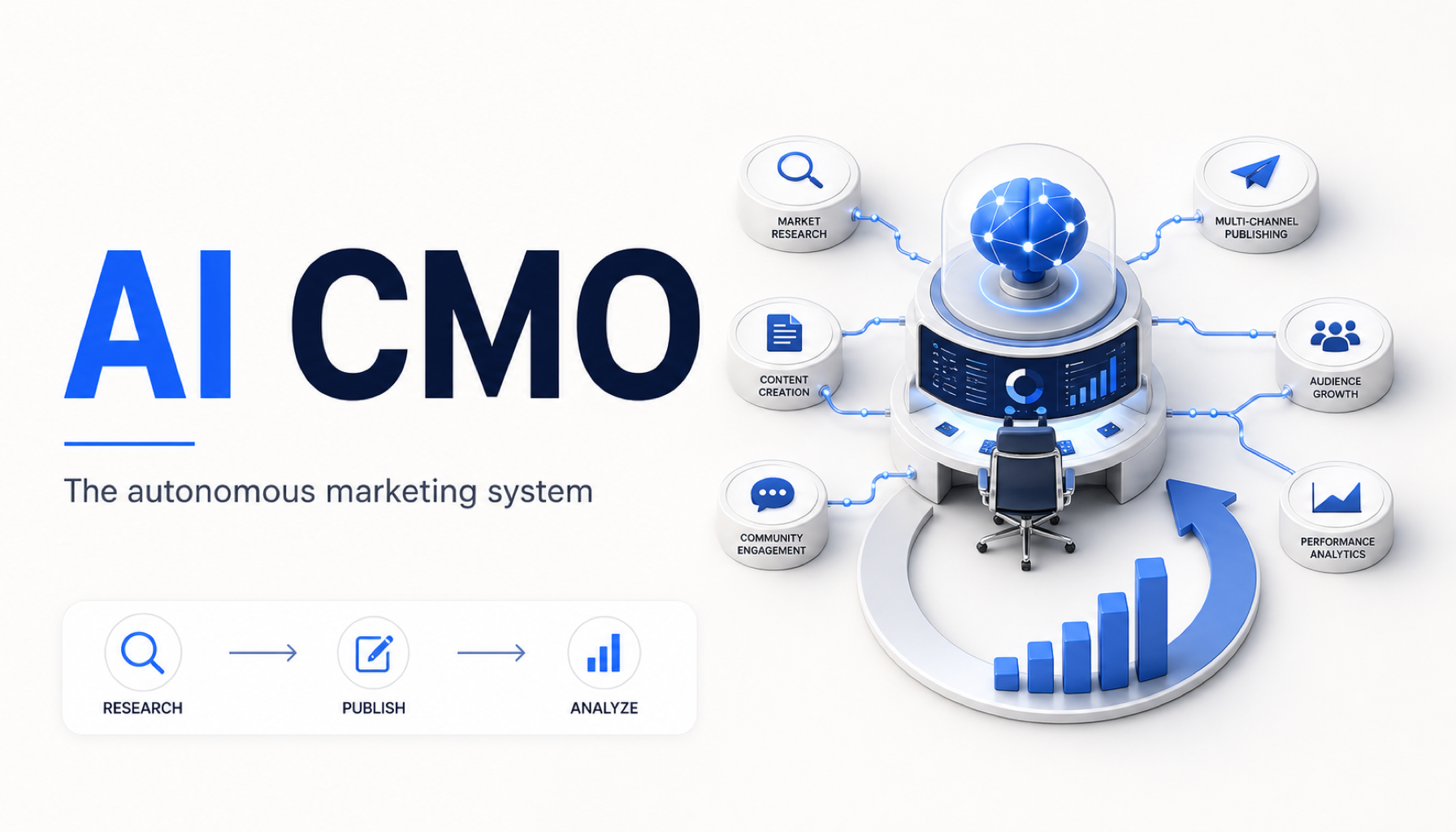
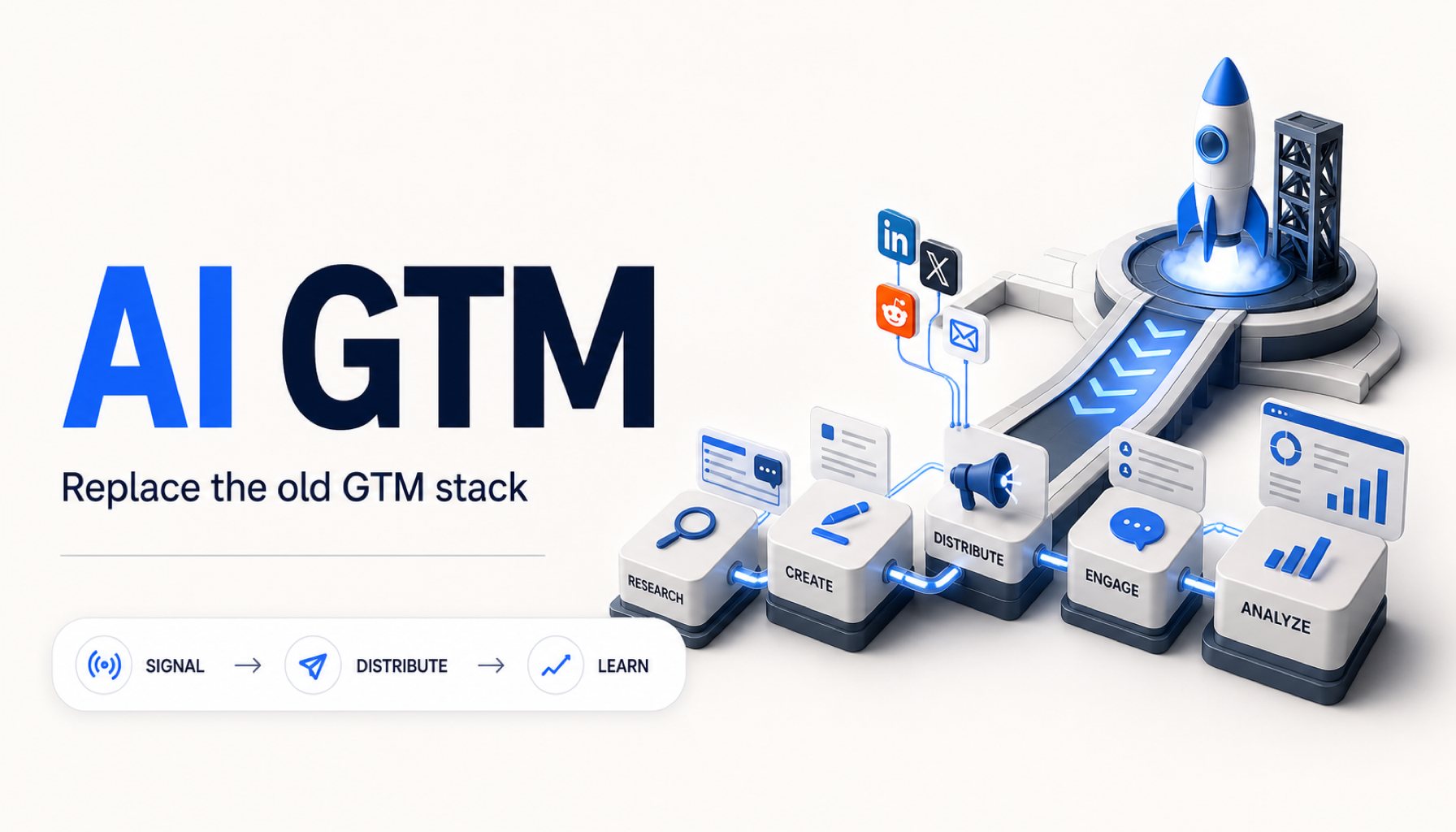
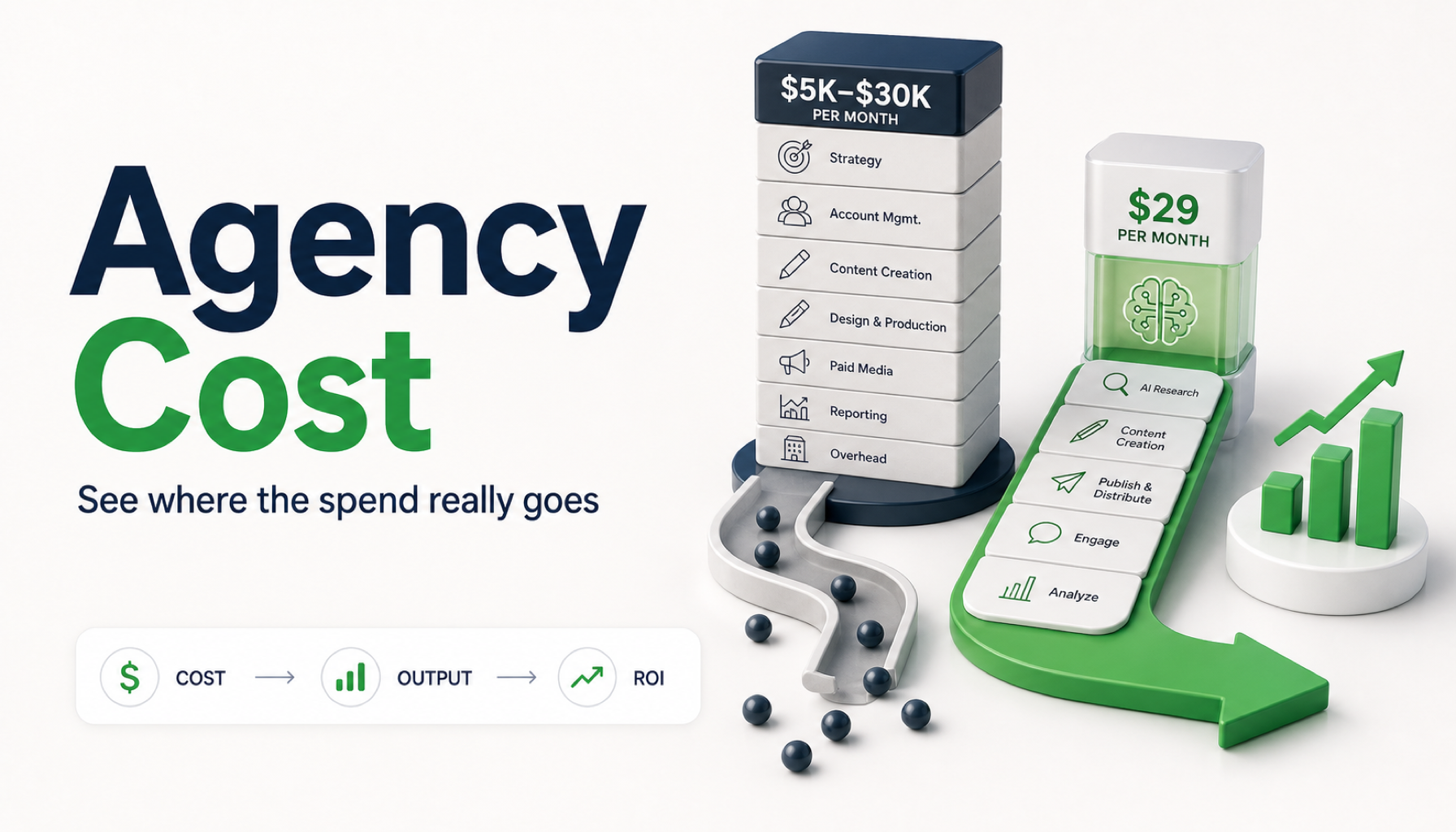
AI Agents
What Is an AI Marketing Agent? (And Why Solo Founders Need One in 2026)
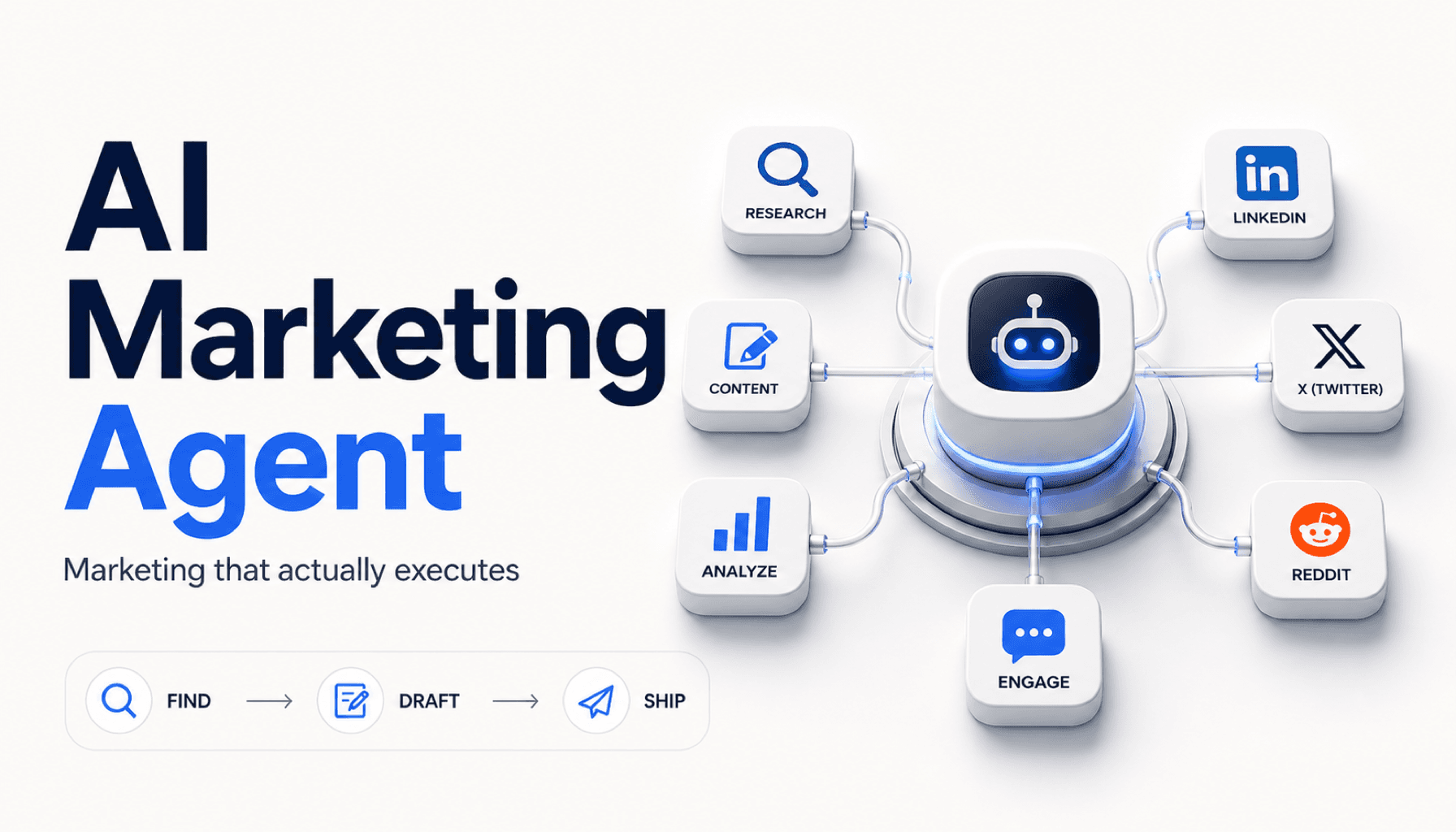
Most solo founders do one of two things with marketing: they either ignore it until they need users badly, or they spend hours a week writing posts, scheduling tweets, and chasing replies that go nowhere. Neither works. The problem isn't effort — it's that marketing is a system, and systems don't run on willpower. AI marketing agents are designed to run that system for you. Not by generating text you still have to edit and post. By executing — researching, drafting, publishing, engaging, and reporting — while you stay in control of the final call.
What an AI Marketing Agent Actually Is
An AI marketing agent is autonomous software that takes a marketing objective and works toward it independently, using tools — APIs, search, social platforms — without requiring you to babysit each step. The word "agent" is doing real work here. It implies a loop: perceive the environment, decide what to do, take an action, observe the result, repeat.
This is categorically different from an AI that waits for your prompt and hands you text. A marketing agent operates on a schedule or a trigger. It reads signals from the internet (mentions of your competitor, threads where your target customer is asking questions, trending topics in your niche), forms a plan, drafts content calibrated to that signal, and submits it for your review or publishes it directly based on your settings.
The architecture behind a well-built marketing agent involves three things: a reasoning layer (an LLM that plans and writes), a tool layer (API integrations that let the agent act — post, search, fetch analytics), and a memory layer (context about your product, voice, past performance, and audience that persists across runs). Without all three, you don't have an agent — you have a chatbot with a scheduler bolted on.
An AI agent that can only generate text is a typewriter with autocomplete. An AI agent that can execute — search, post, reply, analyze — is a junior marketer who works while you sleep.
The transition from generation to execution is what makes 2026 different from 2023. The models got good enough. The tooling caught up. And for solo founders specifically, that shift matters enormously because you're the only person running the whole company.
How Agents Differ from AI Writing Tools
ChatGPT, Claude, Jasper, Copy.ai — these are generation tools. You describe what you want, they produce text, you take it from there. That's useful. But it puts the entire workflow back on you: you still need to research what to write about, figure out where to post it, actually post it, check how it performed, and decide what to do next week.
AI writing tools operate in a single turn. You in, content out. The work of marketing — the research, the distribution, the iteration — remains manual.
Marketing agents operate in a loop. The key distinctions:
- Initiative: Writing tools wait for your prompt. Agents act on schedules, triggers, and signals without needing you to initiate each task.
- Tool access: Writing tools output text. Agents can read Reddit threads, fetch your analytics, post to LinkedIn, send a reply to a comment — they interact with external systems.
- State: Writing tools are stateless across sessions. Agents maintain memory — your brand voice, your ICP, what worked last month, what flopped.
- Scope: Writing tools handle one step. Agents handle a chain of steps, with each step informed by the output of the last.
Think of it this way: a writing tool is a power drill. An agent is a contractor who shows up, figures out what needs doing, does it, and tells you what happened. You still own the house. But you're not the one holding the drill.
The practical implication for solo founders: writing tools reduce time-per-task. Agents reduce the number of tasks on your plate entirely. That's a different order of magnitude.
The 6 Types of Marketing Agents (and What Each One Does)
Modern marketing agent systems aren't a single monolithic bot — they're a team of specialized agents, each responsible for a distinct part of the marketing workflow. Here's how the six agents inside AICMOHQ are structured and what each one actually does:
Scout
Scout is your radar. It monitors Reddit, X/Twitter, LinkedIn, and Hacker News for signals: threads where your target customers are asking questions your product answers, competitor mentions, trending discussions in your niche, and inbound opportunities. Scout doesn't just scrape — it evaluates relevance and surfaces the highest-signal opportunities for the Writer to act on.
Writer
Writer drafts content in your voice — not a generic marketing voice, not a template, your actual tone calibrated from your existing posts and the style profile you set up. It takes Scout's opportunities and turns them into Twitter threads, LinkedIn posts, Reddit comments, or long-form drafts. The output goes into your approval queue, not directly to the internet.
Publisher
Publisher handles scheduling and distribution. Once you approve a draft, Publisher queues it for the optimal time (or the time you specify), formats it correctly for the target platform, and posts it. It also handles thread sequencing for Twitter/X and manages character limits, image attachments, and platform-specific formatting rules automatically.
Engage
Engage monitors the replies and comments on published content and drafts responses. When someone asks a follow-up question on a LinkedIn post, Engage surfaces a draft reply in your queue. This is the difference between content that starts a conversation and content that goes quiet after the first like.
Analyst
Analyst tracks performance across platforms and tells you what's actually working. Reach, engagement rate, click-through, best-performing formats — not raw numbers but interpreted signal. "Your LinkedIn posts about technical decisions get 3x the engagement of your growth posts" is more useful than a spreadsheet of impressions.
ICP Validator
ICP Validator keeps your ideal customer profile current. As you publish and engage, it refines who's actually responding to your content, flags drift between who you think you're targeting and who's engaging, and adjusts Scout's search parameters accordingly. Without this feedback loop, your targeting calcifies around your initial assumptions rather than what the market tells you.
How Agent Chains Work
Individual agents are useful. Agent chains are where the leverage comes from. A chain is when one agent's output becomes the next agent's input — a pipeline that moves from signal to action without human intervention at each handoff.
Here's a concrete example of a full chain running inside AICMOHQ:
- Scout finds a Reddit thread in r/SaaS: "What tools do you use to keep up with marketing as a solo founder?" — 200+ comments, high engagement, your exact ICP asking exactly the question your product answers.
- Scout scores the opportunity and passes it to Writer with the thread URL and a relevance note.
- Writer drafts a Reddit comment that's genuinely helpful (not a pitch), references your product naturally in context, and queues it for approval.
- Writer also drafts a LinkedIn post using the same thread as a jumping-off point: "Saw this question on Reddit and it's the exact problem I built [product] to solve. Here's what solo founders actually need..."
- You review both drafts, approve them with one click.
- Publisher posts the Reddit comment immediately and schedules the LinkedIn post for Tuesday morning.
- Three days later, Engage surfaces four replies to the LinkedIn post — one asking about pricing, two sharing their own frustrations, one asking for a demo.
- Analyst logs that LinkedIn posts seeded from Reddit threads are performing 2.1x above your average engagement rate.
- ICP Validator notes that the responders match a tighter job-title cluster than your current ICP definition, and flags a refinement suggestion.
That entire sequence — from Reddit signal to LinkedIn engagement data — ran with two human interactions: your approval of the two drafts. Everything else executed autonomously. The chain compressed what would normally be three hours of work into fifteen minutes of review.
The Approve-Before-Publish Model
The most common objection to autonomous marketing agents is reasonable: "I don't want a bot posting on my behalf without me seeing it first." Valid. Brand voice is fragile. One off-message post can do more damage than a week of silence.
This is why the human-in-the-loop model matters. The default in well-designed agent systems isn't "post everything automatically" — it's "draft everything, surface for approval, post on confirmation." Autonomous posting is an opt-in, not a default.
In AICMOHQ, the approve mode is the default. Every draft sits in a queue. You review it, edit if needed, approve or reject. The agent learns from your edits over time — if you consistently rewrite a particular phrase or restructure a certain format, that becomes part of your voice model.
Autonomous mode exists for founders who've calibrated their agents enough to trust the output for specific content types — for example, auto-posting short-form X posts while requiring approval for LinkedIn articles. The granularity matters: you might trust the agent to reply to straightforward questions but require review before it posts promotional content.
The practical effect is that you're not doing less thinking about your marketing — you're doing it at a higher level. You're reviewing and approving, not researching and writing from scratch. That's a meaningful shift in how you spend your time.
What a Solo Founder Actually Gets in One Week
Theory is useful. Numbers are more useful. Here's what a realistic week looks like for a solo founder using a full agent stack:
| Day | Agent Activity | Founder Time |
|---|---|---|
| Monday | Scout surfaces 4 high-signal Reddit threads + 2 X discussions; Writer drafts 6 posts across LinkedIn and X | 12 min review + approvals |
| Tuesday | Publisher posts Monday's approved content; Engage surfaces 3 replies needing responses | 8 min reply review |
| Wednesday | Scout finds a trending HN thread; Writer drafts a long-form comment + a LinkedIn thread | 15 min review |
| Thursday | Publisher executes Wednesday's queue; Analyst produces mid-week performance snapshot | 5 min to read the report |
| Friday | ICP Validator surfaces a targeting refinement; Writer drafts a week-in-review post | 10 min review + ICP decision |
Total founder time: roughly 50 minutes across the week. Total output: 10-15 pieces of content across platforms, 8-12 engaged replies, and a performance report with clear signal on what to double down on. Without the agent stack, the same output would require 6-10 hours of dedicated marketing work.
The compounding effect matters too. Week one, the agents are learning your voice and your audience. By week four, the output quality has improved significantly — Writer drafts that need minimal editing, Scout that's surfacing increasingly relevant opportunities, Analyst that has enough data to give you real directional insight.
Current Limitations You Should Know About
Honest assessment matters more than a sales pitch. AI marketing agents in 2026 are genuinely useful, but they have real limitations you need to plan around:
- Voice drift: Even the best voice model will occasionally produce content that sounds slightly off. The approve-before-publish model is your safeguard here, but expect to catch and correct voice drift, especially early in the calibration period.
- Context blindness: Agents don't know what's happening in your life or your company. If you pivot your ICP, change your pricing, or have a PR crisis, you need to update the agent's context manually. It won't pick up on company-level changes without you flagging them.
- Platform API constraints: Social platforms rate-limit and restrict API access. What you can post autonomously via API is sometimes more limited than what you can do manually. X/Twitter in particular has become aggressive about API access.
- Nuance in sensitive topics: If your product operates in a regulated space, handles personal data, or touches politically sensitive territory, agent-drafted content needs more careful human review. Agents are strong at volume and pattern-matching; they're weaker at reading the room on sensitive nuance.
- Cold-start quality: The first week of output is rarely the best week. The agents need signal to get good — your approvals, your edits, your rejections are all training data. Budget for a calibration period.
None of these limitations make agents not worth using. They make them worth using correctly — with clear expectations, active oversight in the early weeks, and a workflow that keeps you in the loop on anything high-stakes.
How to Get Started with AI Marketing Agents
Getting started well is mostly about sequencing. Here's the order that works:
- Define your ICP before you connect anything. Who are you trying to reach? What platforms are they actually on? What problems do they talk about publicly? Vague ICPs produce scattered content. Specific ICPs — "B2B SaaS founders at Series A companies using Vercel and complaining about CAC on Twitter" — give Scout something to work with.
- Connect your platforms. Start with the two channels where your ICP is most active. Don't try to be everywhere on day one — depth beats breadth in the calibration period.
- Run in approve mode for at least two weeks. Don't switch to autonomous until you've seen enough drafts to trust the output quality. Your approval patterns are how the system learns.
- Review the Analyst report at the end of week one and week two. The early signal is noisy, but you'll start to see patterns — formats that land, topics that resonate, platforms where your content gets traction.
- Refine based on ICP Validator suggestions. The first version of your ICP is a hypothesis. Let the data refine it.
The biggest mistake founders make is setting up the agents and then ignoring them. They're not set-and-forget — they're set-and-supervise. The goal is to reduce your time investment from hours to minutes, not to eliminate your involvement entirely. Your judgment about what's on-brand, what's timely, and what's strategically right still matters. The agents just handle the execution.
If you're a solo founder who's been putting off a consistent marketing practice because you don't have the time or the headspace, this is the realistic path forward: not hiring a marketing hire you can't afford, not grinding through another 90-day content calendar you'll abandon by week three, but deploying an agent stack that runs the system while you run the company.
Ready to Automate Your Marketing?
AICMOHQ is built specifically for solo founders who need a full marketing system, not just another content tool. All six agents — Scout, Writer, Publisher, Engage, Analyst, and ICP Validator — work as a connected chain out of the box. Connect your social accounts, set your ICP, and you're getting content drafted within the first hour. The 7-day trial gives you time to see the output before the first charge. Start your AICMOHQ trial and see what a week of autonomous marketing actually looks like for your product.